





















Franklin Joseph Article > Corporate Sexual Harassment During Remote Work and Hybrid Meetings ~ How Online Harassment Works and How to Stop It
By Specialist Franklin Joseph | Expert in Digital Workplace Harassment Prevention and Female Employee Protection | Power to Women Corporate Self-Defence Workshops
Understanding digital workplace harassment in remote and hybrid work environments. How sexual harassment manifests through Zoom, WhatsApp, email, and messaging platforms. Legal rights, documentation strategies, and reporting guidance for Indian professionals.
Why Remote Work and Hybrid Models Created a New Environment for Corporate Sexual Harassment
When Indian corporations shifted to remote and hybrid work models, most organisations updated their technology infrastructure, their project management systems, and their communication platforms. Almost none updated their harassment prevention frameworks to address the new digital environment they had created.
Remote work did not reduce workplace sexual harassment. It relocated it, made it harder to witness, much harder to document, more difficult to report, and in many significant ways, easier for harassers to operate without professional or legal consequence. The physical office had at least the deterrent of colleagues witnessing interactions. The digital workspace created endless opportunities for private, deniable, one-on-one interaction that leaves traces only if deliberately documented.
Zoom calls where everyone else has left the meeting. WhatsApp messages sent late at night. Private Slack messages that disappear if the harasser changes settings. Video calls where the harasser exposes themselves on camera. Email threads that begin professionally and gradually escalate into inappropriate territory. Calendar invites for calls at unusual hours outside business norms.
Each of these is a digital version of the isolation, boundary testing, and escalation that characterises in-person harassment. The medium changed. The predatory sequence did not.
“Remote work gave harassers new tools, new access, and significantly less accountability. It gave victims less visibility, fewer witnesses, and much greater difficulty proving what actually happened. The protection and prevention response must be specifically designed for the digital environment where harassment now occurs.”
Specialist Franklin Joseph, Power to Women Corporate Self-Defence Workshops, Bengaluru
Eight Digital Patterns of Corporate Sexual Harassment in Remote and Hybrid Workplaces
Pattern 1: The Extended One-on-One Video Call Harassment
A supervisor or senior colleague schedules regular one-on-one video calls, often at unusual hours or deliberately outside standard business hours. As with in-person isolation tactics, these calls are presented as work-related or necessary professional development. Over time, comments shift progressively from professional to personal, from professional to sexually inappropriate. The victim is alone with the harasser on camera in their home, and no one else can hear or see what is being said or implied. The digital isolation replicates physical isolation.
Pattern 2: The Lingering Video Meeting Isolation
After a group video meeting ends and other participants have left or dropped the call, the harasser asks the victim to “stay back for a moment to discuss something important.” This replicates the in-person isolation of “come see me after the others leave” using digital tools. Once everyone else has dropped from the call, the harasser makes inappropriate comments, personal advances, or sexual propositions in the private one-on-one video meeting space.
Pattern 3: WhatsApp and Messaging Platform Escalation
What begins as professional messaging on WhatsApp, Microsoft Teams, or Slack gradually escalates in inappropriateness. Personal questions creep into professional conversations. Compliments about physical appearance appear in messages that ostensibly started as work updates. Explicit or sexually suggestive messages eventually follow. The escalation happens deliberately slowly enough that no single individual message looks like the beginning of a coordinated harassment campaign.
Pattern 4: After-Hours and Weekend Digital Contact
Read Franklin Joseph Corporate Women Empowerment / Self Defense ArticlesCall 9886769281 for Corporate WorkshopsThe harasser deliberately sends messages outside business hours and working days. Late evening WhatsApp messages, weekend calls framed as “urgent work matters” requiring immediate attention, or video calls scheduled at 10 PM or later. The after-hours contact normalizes inappropriate access to the victim outside professional working boundaries and subtly signals that professional norms and hierarchies do not apply during these after-hours interactions.
Pattern 5: Camera and Screen Exposure Harassment
A harasser may deliberately expose themselves on video call, show sexually explicit content on their screen during a professional meeting, make inappropriate sexual gestures on camera, or display explicit images. Because the interaction is digital and occurs through a screen, the harasser may believe it is less serious or less provable than in-person physical harassment. This belief is incorrect. Screen-based sexual exposure is a criminal act under Indian law.
Pattern 6: Digital Image and Media Harassment
Sending unsolicited explicit images or videos through professional or personal digital channels. Requesting explicit images or videos from the victim as part of a coercion campaign. Using images or screenshots of the victim in inappropriate or demeaning contexts. These digital harassment behaviours may directly overlap with criminal offences under India’s Information Technology Act.
Pattern 7: Professional Platform Misuse for Personal Advances
LinkedIn messages that begin as professional networking and gradually escalate to inappropriate personal or sexual contact. Email threads that gradually shift from work topics and deliverables to personal questions, romantic interest, or sexual content. Professional platform misuse takes advantage of the professional framing of the initial contact to normalise and legitimise early interactions before progressively escalating.
Pattern 8: Quid Pro Quo Harassment Expressed Through Digital Channels
A supervisor sends digital messages making explicit or implicit connections between the victim’s career advancement, promotion, performance review scores, or job security and their personal availability or reciprocation of advances. Example messages include: “I would love to promote you. Let’s talk about this on a personal call this weekend.” Or: “Your performance review depends on how well we get along personally. Let’s connect this weekend.” This constitutes quid pro quo harassment in digital format and is as illegal and actionable as the same message delivered verbally in an office setting.
Prevention Method 1: Create Digital Professional Boundaries From Day One
Establishing Your Digital Boundary Infrastructure
Just as prevention in physical offices requires eliminating isolation opportunities, prevention in digital workplaces requires establishing clear digital professional boundaries from your first day in a role or with a new supervisor or colleague.
Core Digital Boundary Standards to Establish
- Working Hours Communication Norm: Establish clearly in writing that you respond to work communications during business hours only. Example: “I maintain communication during business hours (9 AM to 6 PM weekdays). For urgent matters outside these hours, please contact [specific person or emergency channel].”
- Platform Boundaries and Standards: Keep work communication strictly on work platforms. Do not share personal WhatsApp numbers, personal phone numbers, or personal social media accounts with supervisors or colleagues unless you have a very clear professional reason and you are completely comfortable with the access it creates.
- Video Call Documentation Norms: For all one-on-one video calls with supervisors, establish a norm of sending written agendas beforehand and written summaries afterward. This creates automatic documentation of every interaction’s professional content.
- After-Hours Communication Response Norm: If you receive work messages after hours that are not genuinely urgent, deliberately delay your response until business hours. This signals that after-hours access is not automatic and is not expected or normal.
How to Name and Address Digital Boundary Violations
When a digital boundary violation occurs (after-hours messages that cross professional lines, personal questions inserted into work channels, inappropriate comments made on video calls), name it the same way you would in person, but always in writing to create documentation:
- “I want to keep our digital communication focused on work matters and professional topics. Please direct any personal conversation through appropriate channels.”
- “I am not comfortable with messages outside business hours that are not work-related. Please respect my working hours and personal time.”
- “That comment on our video call was not appropriate for a professional context. Let’s keep our calls focused strictly on work.”
Naming the boundary in writing creates immediate documentation of both the boundary violation and your clear professional response.
Prevention Method 2: Create and Maintain a Digital Evidence Wall
Why Digital Evidence Is Both Easier to Create and Fragile to Preserve
Digital harassment creates evidence automatically through message logs, email threads, call records, calendar entries, and digital traces. This is one of the few ways digital harassment is actually easier to document than in-person harassment. You do not have to rely on memory of exact words. The words are preserved in the messages themselves.
However, digital evidence is also extremely fragile and can disappear. Messages can be deliberately deleted by the sender or recipient. Chat settings can be changed to auto-delete conversations. Screenshots can be disputed or challenged. Platforms can be discontinued or redesigned. If you do not actively preserve digital evidence at the time harassment occurs, the evidence may be completely gone by the time you formally report.
How to Build and Maintain Your Digital Evidence Wall
- Screenshot everything immediately. The moment you receive an inappropriate message, screenshot it before doing anything else. Save the screenshot outside company systems in a personal email account, personal cloud storage, or personal laptop folder that the organisation cannot access or control.
- Preserve complete message context. When you screenshot a message, include the surrounding messages that show the full conversation context, the sender’s name clearly visible, the platform used, and the timestamp. A screenshot of a single message without identifying information, context, or timestamp is much less useful to investigators.
- Record video call harassment if it is safe and legal to do so. If someone exposes themselves or makes explicit statements on a video call, and your jurisdiction permits recording (check the laws in your state first), record the screen. If you cannot record, document immediately after the call ends: date, time, platform, all attendees, and the exact statement or behaviour observed.
- Save and preserve email threads completely. Do not delete email harassment under any circumstances. Forward the complete thread immediately to a personal email account. Ensure you preserve the full thread including all headers showing sender, recipient, date, and exact time.
- Maintain a written harassment log. Even when you have digital evidence saved, maintain a separate written log describing each incident, what it consisted of, your response, and its impact on your professional performance and wellbeing. The log contextualises the digital evidence for investigators and legal proceedings.
Specialist Training for Remote and Hybrid Work Harassment Prevention
Power to Women Corporate Self-Defence Workshops for Remote and Hybrid Teams
Most corporate harassment training was designed for physical office environments and does not adequately address digital workplace dynamics. Specialist Franklin Joseph’s Power to Women Corporate Self-Defence Workshops for Professionals in Remote and Hybrid Work Environments has been specifically updated to address the unique dynamics of remote and hybrid workplace harassment.
Core training tactics include:
- Tactic 1: Digital Pre-Crime Sequence Recognition — Train your team to identify escalating harassment patterns in digital communication. Learn the specific behavioural signals that indicate a digital harassment dynamic is developing before it escalates to assault, coercion, or criminal behaviour.
- Tactic 2: Digital Boundary Setting and Platform Governance Standards — Develop organisational norms for professional digital communication. Create platform standards that reduce harassment opportunity and increase documentation of all professional interactions.
- Tactic 3: Digital Evidence Wall Building and Preservation — Learn how to capture, organise, and preserve digital harassment evidence in formats that are legally useful and admissible. Understand exactly what digital evidence investigators and lawyers need and how to create and maintain it properly.
- Tactic 4: Remote POSH Act Reporting and Investigation Navigation — Understand how to file and pursue POSH complaints involving digital harassment. Learn how organisations must adapt their Internal Complaints Committee processes for remote work environments.
Krav Maga 1-to-1 Fast-Track for Individual Remote Professionals
For individual professionals experiencing or wanting to prevent harassment in remote and hybrid work settings, Specialist Franklin Joseph’s Krav Maga 1-to-1 Fast-Track provides focused personal coaching. A focused 4-hour intensive session covers four essential tactics:
- Tactic 1: Digital Threat Recognition and Pre-Crime Awareness in Online Workspaces
- Tactic 2: Psychological Boundaries and Professional Confidence in Digital Professional Settings
- Tactic 3: Digital Evidence Building and Documentation Mastery
- Tactic 4: Strategic Reporting and Psychological Resilience After Digital Harassment
Call or WhatsApp: 9886769281
Read Franklin Joseph Corporate Women Empowerment / Self Defense ArticlesCall 9886769281 for Corporate WorkshopsWebsite: PowerToWomen.in
Available across India: Bengaluru, Chennai, Mumbai, Delhi, Hyderabad, Pune, Goa. Online training sessions available for remote professionals working anywhere in India.
How to Report Digital Harassment Strategically
How to Organize and Package Your Digital Evidence for Formal Reporting
Before reporting digital harassment to HR or the Internal Complaints Committee, organise your digital evidence into a clear, comprehensive, chronological package:
- Start with your earliest documentation of the harassment sequence (first inappropriate message, first after-hours contact, first boundary violation)
- Present each incident in strict chronological order with date, time, communication platform, and the specific behaviour or message text
- Include screenshots or forwarded emails as attachments to your written complaint
- Show the full context of each message, not just the most inappropriate content
- Include clear documentation of your professional responses: where you named boundaries, where you redirected to work topics, where you refused inappropriate invitations
How to Submit Your Digital Harassment Report Formally
Submit your formal report in writing to HR or the Internal Complaints Committee. Your written complaint should clearly describe what happened, provide a complete chronological summary of all incidents, reference the digital evidence you are attaching, and state the concrete impact of the harassment on your professional performance and personal wellbeing.
Send your report from a personal email account to a work email address (HR or ICC contact) so you have a sent record outside company systems. Request written acknowledgment in response that your complaint was officially received.
What India’s POSH Act Requires for Digital Harassment Complaints
The POSH Act explicitly covers digital harassment and online workplace abuse. The Internal Complaints Committee is required to investigate complaints involving digital communication with the same rigour and care it investigates in-person harassment. The ICC’s ability to access company communication platforms (Slack, Microsoft Teams, company email, company WhatsApp groups) is an important investigative resource for digital harassment cases.
If you file a POSH complaint about digital harassment, the ICC may be able to access the company’s message logs and server records directly. This means even if the harasser attempted to delete messages on your end, their copies on company servers may still be accessible to the ICC investigators.
Use Platform and Technical Protections
Platform Settings and Technical Features That Protect You
Most digital communication platforms have built-in settings and features that can be used strategically to create documentation and reduce harasser access:
- Email Communication: Forward harassing emails to a personal account immediately. Use “read receipt” requests to create documentation that you received messages. Use the “flag” or “mark important” function to preserve critical emails from deletion if a supervisor tries to instruct you to delete correspondence.
- WhatsApp Messaging: Screenshot messages immediately before taking any other action. Export chat history to email for permanent backup. Block the number if harassment continues after your documented boundary-setting.
- Zoom and Video Call Platforms: Request that all one-on-one meetings be recorded with notification to all parties as required by Indian law and platform policies. If recording is not possible, document the content of each call in writing immediately after it ends.
- Slack and Microsoft Teams: Screenshot conversations immediately before they can be deleted. Use the message search function to locate and preserve historical messages. Note that company platforms have retention policies that preserve deleted messages on company servers even after deletion on your device.
How Digital Evidence Is Used in Investigations and Legal Proceedings
Digital harassment evidence is fully admissible in POSH Act investigations and in civil legal proceedings in India. Screenshots, email records, call logs, message exports, and server records are all forms of admissible evidence. Your employment lawyer can advise on the most effective way to present digital evidence in a civil proceeding or before an investigator.
If the harassment included criminal behaviour (on-screen sexual exposure, explicit image sharing without consent, criminal threats), digital evidence may also be used in criminal proceedings in court. Preserve all digital evidence carefully and deliberately, and do not alter it in any way, as alteration can undermine its legal admissibility.
How Organisations Must Update POSH Compliance for Remote and Hybrid Work
Why Traditional POSH Compliance Frameworks Are Insufficient for Digital Workplaces
Most organisations established their Internal Complaints Committee processes and POSH Act compliance frameworks before remote and hybrid work became the norm. These frameworks were designed entirely for physical office environments. They address in-person harassment procedures, physical workspace safety protocols, and face-to-face reporting processes.
Traditional POSH frameworks do not adequately address: digital harassment via company or personal platforms, after-hours digital contact patterns, video call harassment, harassment in non-company-owned digital spaces, or the specific evidence-handling requirements for digital harassment complaints.
What Organisations Must Add to POSH Compliance for Digital Workplaces
- Explicit policy coverage of all digital communication platforms, including personal platforms used for work purposes (WhatsApp, personal email, personal social media)
- Clear guidelines on appropriate working hours communication norms and after-hours contact expectations
- Mandatory training for Internal Complaints Committee members on digital evidence collection, preservation, and proper assessment
- Anonymous digital reporting mechanisms that allow employees to report harassment without identifying themselves initially
- Clear policies on video call recording, consent requirements, and how recordings are used as evidence
- Specific investigative provisions for harassment that occurs on personal platforms and outside company control
The Psychological Impact of Digital Harassment
Why Digital Harassment Has Distinct Psychological Effects
Read Franklin Joseph Corporate Women Empowerment / Self Defense ArticlesCall 9886769281 for Corporate WorkshopsDigital harassment has psychological dimensions and impacts that differ from in-person harassment in important and significant ways:
- It follows you into your home. In-person harassment, while deeply damaging, is at least spatially confined to the workplace building. Digital harassment enters your home through your phone and computer. A harassing WhatsApp message arriving at 11 PM invades your personal space and private sanctuary in a way that a comment in an office cannot.
- It is always immediately accessible. Digital harassment messages exist in your pocket, on your desk at home, on your personal devices. The harassment is always within reach, making psychological distance and emotional recovery much harder to achieve.
- It blurs work and home boundaries completely. Remote work already blurs the physical boundary between work and home. Digital harassment compounds this by making the harassment itself borderless and location-independent.
- It creates permanent documentation of the violation. While useful as evidence for reporting, seeing the harassing messages repeatedly in your message history is retraumatising. Each time you scroll past the messages to find something work-related, you re-encounter the violation.
How to Protect Your Psychological Space During and After Digital Harassment
- After carefully preserving screenshots and complete documentation, archive the harassing messages in a folder you do not encounter in your daily scrolling. Keep the evidence safely stored without keeping it visible in your daily workspace.
- Set strict technology boundaries after work hours: phone in another room, notifications turned off for work platforms after a set time each day.
- Tell someone you trust what is happening. The secrecy and shame that digital harassment depends on is dissolved when you speak the truth to a safe, supportive person.
- Access mental health support and counselling. Digital harassment-related trauma responds well to the same therapeutic approaches used for in-person harassment trauma.
India’s Legal Framework: IT Act and Digital Harassment
Information Technology Act 2000 Protections for Digital Harassment
India’s Information Technology Act, 2000 (as amended in 2008) provides significant additional legal protections against digital harassment beyond the POSH Act. Specific relevant provisions include:
- Section 66A: Addresses sending offensive electronic messages (note: this section was struck down by the Supreme Court in 2015 but may inform civil claims for damages)
- Section 66C and 66D: Address identity theft and cheating by personation through electronic communication
- Section 67: Addresses publishing or transmitting obscene material in electronic form. This covers sending explicit images without consent.
- Section 67A: Specifically addresses publishing material containing sexually explicit acts in electronic form. This is directly applicable to sending explicit images or videos without consent.
- Section 72: Addresses breach of confidentiality and privacy through electronic communication
How to Combine POSH and IT Act Claims for Maximum Legal Protection
For digital workplace harassment, you may have legal grounds for both a POSH Act complaint (workplace harassment) and criminal or civil claims under the IT Act (digital law violations). An employment lawyer or cyber law specialist can advise on how to structure claims across these legal frameworks to maximise your legal protection and potential remedies.
Comprehensive Training for Corporate Teams and Individual Professionals
Power to Women Corporate Self-Defence Workshops for Remote Teams
Specialist Franklin Joseph’s Power to Women Corporate Self-Defence Workshops for Professionals in Remote and Hybrid Work Settings are available for organisations with remote, hybrid, or geographically distributed teams. Training is delivered online or in-person depending on your team’s location and work structure. Trusted by Fortune 500 companies including Google, Amazon, Goldman Sachs, and DRDO. Rated 4.9 stars from 200 plus verified reviews.
Contact for Corporate Workshop Booking:
Call or WhatsApp: 9886769281
Website: PowerToWomen.in
Krav Maga 1-to-1 Fast-Track for Individual Professionals
Franklin Joseph’s Krav Maga 1-to-1 Fast-Track provides a 4-hour intensive personal coaching session for individuals who want comprehensive personal safety training covering both physical and digital professional environments. The four core tactics covered in this intensive session are:
- Tactic 1: Digital and Physical Pre-Crime Sequence Recognition
- Tactic 2: Boundary Setting and Verbal Confidence Across In-Person and Digital Contexts
- Tactic 3: Digital Evidence Building and Physical Safety in Hybrid Work Settings
- Tactic 4: Strategic Reporting and Psychological Resilience After Digital Harassment
Call or WhatsApp: 9886769281
Website: PowerToWomen.in
Online coaching sessions available for professionals working remotely anywhere in India.
Remote work changed the workplace fundamentally. Your safety training needs to change with it. Get the specialist knowledge designed for the digital professional environment.
Digital Harassment Documentation Checklist for Every Incident
Immediate Actions for Every Digital Harassment Incident
- Screenshot immediately before doing anything else or responding
- Capture full context including sender name, platform used, and exact timestamp
- Save screenshot to personal account outside company systems
- Record in written harassment log: date, time, platform, complete description, impact on you
- Do not delete messages, even if they make you extremely uncomfortable to keep stored
Specific Actions for Email Harassment
- Forward complete email thread with all headers to personal email immediately
- Do not delete or archive from company account
- Document in harassment log with specific reference to saved email for future reference
Specific Actions for Video Call Harassment
- If safe and legal in your state, record the screen during the call
- If recording is not possible, document in writing immediately after call: date, time, platform, all attendees, exact behaviour or statement observed
- Note whether any other person was present who could corroborate what happened
Specific Actions for WhatsApp or Messaging Platform Harassment
- Screenshot before opening message (to preserve unread status for timestamp verification)
- Export complete chat history to email for permanent backup
- Do not delete or archive to trash until after Internal Complaints Committee or legal proceeding is completely finished
Key Takeaways: Corporate Sexual Harassment in Remote and Hybrid Work Settings
- Remote work relocated and amplified harassment opportunity. The predatory sequence is the same. The digital medium requires different prevention and documentation strategies.
- Eight common digital harassment patterns include extended one-on-one video calls, lingering meetings, messaging escalation, after-hours contact, camera exposure, digital image harassment, professional platform misuse, and digital quid pro quo harassment.
- Prevention requires establishing digital professional boundaries from your first day: communication hours, platform standards, video call documentation norms.
- Digital evidence is both easier to create and more fragile than in-person evidence. Screenshot immediately and save outside company systems.
- POSH Act explicitly covers digital harassment. Internal Complaints Committee investigations can access company communication platform records.
- India’s IT Act provides additional criminal and civil protections for digital harassment including explicit image sharing without consent.
- Organisations must update POSH compliance frameworks to explicitly cover digital platforms and remote work environments.
- Digital harassment is psychologically distinct. It follows you home. Protect your psychological space deliberately.
- Combine POSH Act and IT Act claims for maximum legal protection and remedies.
Resources and Support Services for Digital Harassment in India
- National Cyber Crime Reporting Portal: cybercrime.gov.in (for IT Act violations including explicit image sharing)
- National Sexual Harassment Helpline: 1800-233-1001
- AASRA Mental Health Helpline: 9820466726
- iCall Emotional Support Helpline: 9152987821
- Your Company’s Internal Complaints Committee: File POSH complaint for digital workplace harassment
- Employment or Cyber Law Lawyer: For combined POSH and IT Act claim strategy and legal representation
- State Cyber Crime Cell: For criminal digital harassment including explicit image sending without consent
Franklin Joseph TEDx Talk Speaker on Combat Science ~ How Threat Recognition Pre-Attack Behaviour and Krav Maga Self-Defence Science Protect Indian Women Corporate Professionals
Read Franklin Joseph Corporate Women Empowerment / Self Defense ArticlesCall 9886769281 for Corporate WorkshopsSpecialist Franklin Joseph’s methodology for women’s safety gained international attention on TEDx. He used this platform to debate conventional defense wisdom and introduce the core principles of his Power to Women Corporate Self-Defense Workshop.
He addresses the systemic failure of traditional methods and the urgent need to base training on criminal psychology. His system successfully pairs Israeli Military Krav Maga with upwards of 21 psychological tactics to handle real threats.
HR directors and corporate leaders praise this approach for pushing past token safety measures to deliver transformative, practical skills.
Watch the full session here: Specialist Franklin Joseph TEDx Talk on Women’s Safety
Related Articles in This Comprehensive Series
- 3 Ways to Avoid Corporate Sexual Harassment at Work: Prevention Guide for Indian Professionals
- 3 Ways to Exit Corporate Sexual Harassment: Evidence-Based Recovery Guide
- Male Victims of Workplace Sexual Harassment: Legal Rights and Civil Action in India
- Racial Harassment Combined With Sexual Coercion: Compound Trauma and Documentation Strategy
- POSH Act Internal Complaints Committee Process: Step by Step Filing Guide
- Bystander Intervention in Corporate Sexual Harassment: What Colleagues Can Do
- Sexual Harassment by Clients and Vendors: Legal Rights for Indian Professionals Outside the Office
Disclaimer and Legal Notice
This article provides general information about digital workplace harassment under India’s Prevention of Sexual Harassment of Women at Workplace Act, 2013, and Information Technology Act, 2000. It does not constitute legal advice. Laws and digital platform policies change continuously. For specific legal guidance regarding your digital harassment situation, consult a qualified employment lawyer or cyber law attorney licensed to practice in India. Information Technology Act provisions referenced are current as of publication date and may be subject to amendment or judicial reinterpretation.
Related Resources and Links:
- Power to Women Corporate Self-Defence Workshops for Professional Women
- Krav Maga 1-to-1 Fast-Track for Women and Men
- About Specialist Franklin Joseph
- Download Resources and Helplines PDF
Published by: Specialist Franklin Joseph, Power To Women Corporate Self Defense Workshops
Location: Bengaluru, India
Professional Credentials: TEDx Speaker. Trained NSG Black Cat Commandos, IAS, IPS, and IRS officers. Trusted by Fortune 500 companies. Rated 4.9 stars from 200 plus verified reviews.
Contact: 9886769281 | PowerToWomen.in
Corporate Self Defence Workshops ~ 'Embrace Inner Power'
Our all-encompassing strategy combines state-of-the-art Israeli Military Krav Maga self-defence methods with revolutionary psychological tactics like to help you maintain composure, assertiveness, and control whether you're negotiating a high-pressure boardroom or an unpredictable street or domestic encounter. Don't hesitate; give Specialist Franklin Joseph a call @ 9886769281 right now to learn the most important skills and become a part of the movement towards empowered life.
Connect with Specialist Guruji Franklin Joseph for
Women Emergency All State Helpline Directory Guide
PDF - Click to Download India State-Wise Women Emergency Helpline DirectoryARTICLE - Read Online Basic Corporate Self-Defense & Women Emergency Resource Guide

Corporate Workshops Clients
Other Posts & Articles

Jain International Trade Organisation (JITO) Power To Women Self Defense Workshop

ESKO India International Women’s Day Corporate Self-Defence Workshop Bengaluru

Google Women Techmakers Bengaluru ~ Power To Women Krav Maga Self-Defence and Psychological Women’s Empowerment Workshop by Franklin Joseph

Arvind Mills Women Employee Safety Training ~ Power To Women Corporate Self-Defence Workshop Case Study

Larsen & Toubro Technology Women’s Empowerment Workshop ~ Corporate Self Defence Training Case Study Bengaluru

Amazon India Employee Safety Training ~ Online Corporate Women’s Empowerment Workshop Case Study Bengaluru

Deccan Chronicle Newspaper Article ~ Dr. Safety Franklin Joseph’s Women Empowerment Initiative Bringing Real Change to Visakhapatnam Communities

Dainik Jagran Newspaper Article ~ Learn the real self defense from Dr. Safety Franklin Joseph

The New Indian Express Newspaper Article ~ Dr Safety who empowers the psyche
Call 9886769281 for Corporate Workshops From Childhood Trauma to Safety Empowerment: Dr. Safety's Transformational Journey Guruji Franklin Joseph, Founder and CEO of the Indian Institute of Threat-Intelligence Analysis ...
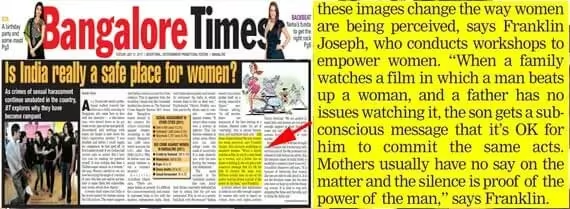
Bangalore Times Newspaper Article ~ Is India really a safe place for women?

Deccan Chronical Newspaper Article ~ Krav Maga Work your mind

Times of India Newspaper Article ~ Women execs learn to defend themselves

Franklin Joseph Article > Why Corporate Self-Defence Training for Women Is Not About Fighting ~ It Is About Coming Home Safe

Franklin Joseph Article > Corporate Sexual Harassment During Remote Work and Hybrid Meetings ~ How Online Harassment Works and How to Stop It

Franklin Joseph Article > Sexual Harassment by Clients and Vendors ~ Legal Rights for Indian Professionals Outside the Office

Franklin Joseph Article > Female Victims of Workplace Sexual Harassment ~ POSH Act Rights ICC Complaint Process and Recovery Strategies in India

Franklin Joseph Article > POSH Act Internal Complaints Committee Process ~ Step by Step Guide for Filing Workplace Sexual Harassment Complaints in India

Franklin Joseph Article > Bystander Intervention in Corporate Sexual Harassment ~ What Colleagues Can Do When They Witness Harassment at Work

Ms. Priyamvada Advocate – Krav Maga Self Defence Training Impact on her Solo Travel Safety ~ Professional Women’s Transformation Through Corporate Empowerment Workshop
About Specialist Franklin Joseph