





















Last updated on May 13th, 2026 at 08:17 pm
Franklin Joseph Article > 3 Ways to Avoid Corporate Sexual Harassment at Work ~ Prevention Guide for Indian Professionals
By Specialist Franklin Joseph | Specialist, Power to Women Corporate Self Defence Workshop | Franklin Joseph Krav Maga Bengaluru
Evidence-based prevention strategies based on real workplace harassment case analysis. This content teaches psychological self-defense skills to corporate professionals across India.
Franklin Joseph TEDx Talk Speaker on Combat Science ~ How Threat Recognition Pre-Attack Behaviour and Krav Maga Self-Defence Science Protect Indian Women Corporate Professionals
Specialist Franklin Joseph brought his unique approach to women’s safety to the TEDx stage. His presentation dismantles decades of standard self-defense advice and introduces the proven methods driving the Power to Women Corporate Self-Defense Workshop.
He breaks down the recurring failures of standard training programs and highlights the necessity of using criminal psychology to design effective courses. By fusing Israeli Military Krav Maga with more than 21 mental strategies, he offers a robust safety framework that transcends basic physical moves.
This message has struck a chord with HR executives and safety coordinators who understand that real empowerment requires practical skills rather than empty promises.
Watch the complete presentation here: Specialist Franklin Joseph TEDx Talk on Women’s Safety
How Corporate Sexual Harassment Starts: Understanding the Pre-Crime Sequence
A senior executive at a major tech corporation. A junior employee. A pattern of behavior that began with seemingly innocent gestures and escalated into alleged assault. This lawsuit, filed in early 2024, illustrates how workplace harassment rarely begins with overt violence. It begins with boundary testing.
According to allegations, the harassment followed what Specialist Franklin Joseph identifies as the Pre-Crime Sequence. It started with a dropped pen, physical proximity, casual personal comments. It escalated through drink invitations, explicit remarks, career threats, and racial slurs. By the time alleged assault occurred, the victim had been psychologically isolated for months.
This isolation is the trap. Traps do not snap shut instantly. You walk into them one boundary violation at a time because no single step looks dangerous enough to stop.
Read Franklin Joseph Corporate Women Empowerment / Self Defense ArticlesCall 9886769281 for Corporate Workshops“Predators look for vulnerabilities, whether on the street or in the boardroom. Corporate harassers follow the same behavioral patterns as criminals. The difference is they use professional leverage instead of physical force.”
Specialist Franklin Joseph, Bengaluru Corporate Safety Trainer
Before learning how to avoid the trap, you need to understand what it looks like. The warning signs are psychological, not physical. Once you recognize them, you can stop the sequence before it begins.
Corporate Sexual Harassment Prevention Method 1: Recognize Pre-Crime Behavior Patterns Early
What Is the Corporate Pre-Crime Sequence?
In street crime, predators study your routine, test your awareness, and strike when you are vulnerable. In corporate settings, predators do the same thing with performance reviews, one-on-one meetings, after-work invitations, and personal comments about your appearance or relationships.
Each step is a boundary test. If you respond without pushing back, the next test crosses further across the line. If you accept the first invasion of space, the harasser knows the second will also be accepted. This is not paranoia. This is how predatory behavior actually works.
According to the lawsuit allegations, the sequence in this case included deliberate physical touch disguised as an accident (dropping a pen), sexually explicit verbal comment immediately following that touch, escalating drink invitations, and eventually explicit verbal threats. Each one of those steps was a checkpoint where the victim could have named the boundary.
Why Boundary Testing Works on Intelligent People
The reason boundary testing works is that each individual step is small enough to rationalize. A pen drops. Maybe it was accidental. A comment is made. Maybe I misunderstood the intent. An invitation to drinks is offered. That seems like normal work socializing. By the time the pattern becomes unmistakable, you have already accepted several escalations. Pushback now looks like you are overreacting, when in fact you are finally reacting appropriately.
This is the psychological trap. It is not designed to be obvious. It is designed to be deniable at every stage.
How to Apply This Prevention Strategy: Name Boundaries Immediately and in Writing
The moment a superior makes physical contact that feels wrong, a comment that crosses a professional line, or an invitation that feels like a test of your personal compliance, name it. Not aggressively. Not with accusation. Simply name it calmly and professionally in that moment.
Examples of immediate, professional boundary-naming:
- “I prefer to keep our working relationship strictly professional.”
- “I am not comfortable with that type of comment. Let’s keep our conversations focused on work.”
- “I need to decline that invitation. I prefer to keep work and personal time separate.”
- “That physical contact makes me uncomfortable. Please do not do that again.”
Follow up this verbal boundary with a written message sent within the same day:
“I wanted to follow up on our conversation today regarding [specific incident]. I want to make sure we maintain a strictly professional working relationship. I would appreciate it if we focus our interactions on work matters going forward.”
This written follow-up serves two critical purposes. First, it creates a timestamped record that you named the boundary. Second, it signals to the harasser that you are paying attention and that you will document what you see. Most harassers do not persist when their first moves are cleanly and calmly named. They seek the path of least resistance. If the resistance becomes documented, they typically move on.
“When a boundary is crossed without consequence, the harasser gets a green light. They depend on your silence because silence means yes. A calm, professional naming of the boundary breaks their pattern.”
Specialist Franklin Joseph, Bengaluru
What to Do If Boundary Naming Does Not Work
If you name a boundary and the behavior continues, you have immediately moved from prevention into documentation mode. You now have proof that the person persisted after being told to stop. This is gold in any investigation or legal proceeding. Save every subsequent message. Document every subsequent incident. The harasser has just given you clear evidence of intentional, deliberate behavior.
Corporate Sexual Harassment Prevention Method 2: Eliminate Professional Isolation Opportunities
Why Isolation Is the Harasser’s Most Important Tool
Every escalation in the alleged harassment sequence in the recent case occurred in private. The drink invitation was designed to move the interaction away from the office. The alleged incident at the victim’s apartment was a private setting. The only reason an adjacent room witness even existed was apparently by accident.
Read Franklin Joseph Corporate Women Empowerment / Self Defense ArticlesCall 9886769281 for Corporate WorkshopsThis is not coincidence. Harassers understand this fundamental truth: what happens in isolation has no witness, no documentation, and no corroboration. Isolation is not a convenience for them. It is operational necessity. A harasser cannot escalate behavior when there is a third person present. They cannot deny saying something when someone else heard it. They cannot claim misunderstanding when multiple people witnessed the interaction.
Your primary defense against isolation is professional discipline. If you make isolation impossible, the harasser cannot operate.
How Professional Isolation Gets Disguised
Harassment experts recognize that isolation is often presented in normalized professional language. “Let’s grab a coffee and talk about your performance.” “Come see me after the others leave.” “I’ll explain the project structure better over drinks.” “Let’s meet at my apartment to discuss the strategy in a more relaxed setting.”
Each of these is a normal-sounding professional frame wrapped around an isolating move. The professional language makes you feel like questioning the isolation is rude or paranoid. It is not rude. It is necessary.
How to Apply This Prevention Strategy: Create Your Professional Isolation Boundaries
Create a personal professional norm: all substantive work discussions happen in settings where other people are present or where a written record exists.
If a meeting needs to happen one-on-one, ensure one of the following:
- The meeting occurs in a glassed-in office where your interaction is visible to others passing by.
- Your office has a transparent door or window policy.
- You send a written follow-up email immediately after the meeting summarizing what was discussed.
- You keep your office door open during one-on-one meetings.
- You meet in a semi-public space like a coffee area or conference room lobby rather than a closed office.
The written follow-up email is particularly powerful. “As we discussed today, here are the key points from our meeting: [summary of discussion].” This creates a paper record of every interaction. It proves what was discussed. It creates a timeline. If the harasser later claims something was said that was not, you have a contemporaneous written record proving otherwise.
The harasser’s power depends on no record existing. Your protection depends on records existing.
What to Do If Someone Pressures You Into Isolation
If your supervisor or colleague regularly pressures you to meet privately despite your polite refusals, this is itself a red flag that needs documentation. Messages like “I prefer to keep work meetings in office settings” or “I work best when there are open communication channels” create a record that you resisted isolation.
If pressure continues, escalate the boundary. “I am not comfortable meeting outside the office setting. All my work discussions happen during office hours in company spaces.” This is not rude. This is reasonable professional boundary that you are entitled to set.
Corporate Sexual Harassment Prevention Method 3: Build Your Evidence Documentation System Before You Need It
Why Evidence Documentation Determines Outcomes
In the recent case, the company’s internal investigation reportedly concluded there was no merit to the claims, in part because the complainant was overwhelmed during the internal review process. Whether that assessment was fair or not, it illustrates a core reality of workplace harassment complaints: they come down to documented evidence versus verbal denial.
The person with clear, contemporaneous, timestamped documentation wins more often than the person without it. Not always. But more often. When it comes to your career, your safety, and your future, “more often” is worth the effort of maintaining documentation.
What Your Evidence Documentation System Contains
Read Franklin Joseph Corporate Women Empowerment / Self Defense ArticlesCall 9886769281 for Corporate WorkshopsAn Evidence Wall is a private, timestamped, detailed log of every incident that makes you uncomfortable. It includes all of the following information for each incident:
- Date of incident (exact date, not approximate)
- Time of incident (morning, afternoon, specific hour if known)
- Location where incident occurred (specific room, building, setting)
- Exact words used as best you can recall them (use quotation marks only if you are confident about the exact wording)
- Your internal response (what you were feeling, thinking, wanting to do)
- How you responded (what you actually said or did)
- Any witnesses present (names if possible, or descriptions if names are unknown)
- Any physical evidence related to the incident (messages, emails, meeting calendar entries, gifts, notes)
You do not build this documentation system after the situation has escalated. You build it from the first uncomfortable moment. If nothing ever comes of it, you have wasted a few minutes of your time. If something does come of it, you have saved everything.
How to Apply This Prevention Strategy: Start Your Documentation Today
Keep a private document outside company systems. Store it in a personal email account, a personal laptop file, a personal notebook, or a personal cloud storage account that is not connected to your company systems. This is important because your company can subpoena company-stored documents.
Record every incident within 24 hours while the details are still clear in your memory. Do not wait weeks to document something. Do not try to remember details from months ago. The contemporaneous nature of your documentation is part of what makes it credible.
Save every message, every meeting invite, every email where something felt wrong. Screenshots are acceptable. Keep them organized by date.
If you receive a verbal threat or inappropriate comment, consider following it up in writing within the same day: “I wanted to make sure I understood you correctly when you said [paraphrase]. Is that accurate?” This approach accomplishes several things. It creates a written record of the incident. It gives the harasser a chance to either confirm their inappropriate statement (which is then documented) or deny it (which is then also documented as a record of what happened). Either way, you have moved the conversation into a documented format.
“You are not being paranoid by documenting uncomfortable interactions. You are operating with the same professional discipline that soldiers use when they know the terrain is hostile. Soldiers do not wait to be attacked before they study the map.”
Specialist Franklin Joseph, Power To Women Corporate Workshop
How Your Evidence Documentation Protects You
Evidence documentation protects you in multiple ways:
- If you need to file an internal complaint, you have specific dates, words, and witness information rather than vague recollections.
- If the company investigates, you have a contemporaneous record that predates any investigation, making it more credible.
- If you need to file a civil lawsuit, your attorney has a clear timeline and specific incidents to work with.
- If your career is damaged by the harassment, you have evidence of the timeline that proves causation.
- If the harasser tries to reframe the situation or claim misunderstanding, you have documented proof of what actually happened.
Most importantly, documentation changes the psychological dynamic between you and the harasser. When you are secretly maintaining an accurate record of their behavior, you regain a sense of agency and control. You are no longer just experiencing violations. You are collecting evidence. You are building a case. This shift in mindset is protective, even before any formal investigation begins.
Three Prevention Strategies Work Together: The Defense System
These three prevention methods are not independent. They work together as an integrated defense system:
- When you recognize pre-crime sequences early and name boundaries immediately, you signal to potential harassers that you are aware and vigilant.
- When you eliminate opportunities for isolation, you reduce the harasser’s ability to operate without witnesses or documentation.
- When you maintain evidence documentation, you create a record that proves you named boundaries and resisted isolation.
Together, these three strategies make you a poor target for workplace harassment. Most potential harassers are looking for vulnerability. When you demonstrate awareness, documentation, and boundary-setting, you demonstrate that you are not a soft target. Most will move on to someone else.
Some will not move on. Some will escalate because they are committed to the pursuit or because they believe their institutional power makes them untouchable. If that happens to you, your documentation, your boundary-naming, and your refusal to isolate have prepared you to respond strategically rather than emotionally.
Why Male Professionals Need These Prevention Strategies
Read Franklin Joseph Corporate Women Empowerment / Self Defense ArticlesCall 9886769281 for Corporate WorkshopsSexual harassment in corporate settings is not only a problem for women. While the majority of reported cases involve female victims, male professionals also experience workplace sexual harassment. The patterns are the same. The isolation tactics are the same. The boundary-testing sequences are the same.
Male victims often face additional barriers to reporting: cultural stigma, lack of statutory protection under India’s POSH Act, fear of not being believed, and fear of being blamed for the harassment. These barriers make prevention even more critical for male professionals. If you can avoid the situation entirely, you avoid all of these complications.
If you are a male professional in a corporate environment, these prevention strategies apply to you just as much as they apply to female professionals. Do not assume it cannot happen to you. Do not assume that your position, your background, or your appearance makes you immune. Harassment targets vulnerability, not demographics. Awareness, documentation, and boundary-setting protect everyone equally.
Prevention in Practice: What This Looks Like in Real Corporate Settings
Scenario 1: The Performance Review That Crosses a Line
Your manager calls you into their office for a routine performance review. Partway through, they make a personal comment about your appearance. “That color really suits you. You look good today.” It is a compliment, technically. But it makes you uncomfortable because it is not about your work performance.
Prevention Response:
- In the moment: “Thank you, but I would prefer we focus on my work performance and career development.”
- Follow-up within 24 hours via email: “I appreciated the feedback in today’s performance review. For future reviews, I would prefer we keep our discussion focused on work performance and professional development. I work best when our relationship stays on a professional level.”
- Documentation: Record the date, time, exact words, and the fact that you named the boundary in follow-up email.
Scenario 2: The After-Work Drinks Invitation
A senior colleague invites you out for drinks after work to “discuss some ideas.” The invitation is presented casually, but you sense something off about it. You have noticed this person tends to be overly friendly and has crossed boundaries with other colleagues before.
Prevention Response:
- In the moment: “I appreciate the invitation, but I have other plans. If you have work ideas to discuss, let’s schedule that for our team meeting or during office hours.”
- Follow-up via message: “Thanks again for the invitation. I prefer to keep work discussions in office settings where we have documentation and context.”
- Documentation: Record the invitation, your decline, any follow-up pressure, and any subsequent concerning behavior from this person.
Scenario 3: The Isolated One-on-One Meeting
Your manager wants to meet with you one-on-one to discuss a confidential project. They suggest meeting at their apartment on a weekend or at a private coffee shop rather than in the office.
Prevention Response:
- In the moment: “I would prefer to meet in the office during business hours. That works better with my schedule and ensures we have proper documentation of project details.”
- If pressure continues: “All my work meetings happen in office settings. That is my professional standard.”
- Follow-up via email: “To confirm, we will meet in the conference room on [date] at [time] to discuss the project. I will send a meeting summary afterward.”
- Documentation: Record the request for isolated meeting, your refusal, and any pushback you receive.
Hire Specialist Franklin Joseph: 1:1 Krav Maga Corporate Self Defense Fast-Track
Prevention requires both psychological awareness and physical confidence. Specialist Franklin Joseph’s 4-Hour 1:1 Krav Maga Fast-Track Coaching combines psychological self-defense training with practical techniques specifically designed for corporate professionals.
What This 4-Hour Fast-Track Includes:
- Tactic 1: Boundary Recognition and Verbal De-Escalation – Learn to recognize micro-aggressions and inappropriate behavior before they escalate. Master calm, firm verbal responses that establish professional boundaries.
- Tactic 2: Personal Space Control and Physical Confidence – Understand how predators read body language and posture. Practice positioning and distance management that signals confidence and awareness.
- Tactic 3: Escape and Avoidance Techniques – Learn practical physical techniques to create distance and escape from physical violation. No unnecessary combat. Only strategic escape.
- Tactic 4: Evidence Documentation and Psychological Resilience – Master the framework for building your Evidence Wall. Develop the psychological resilience to resist trauma bonding and maintain clarity during manipulation.
Why Individuals Choose This Training:
- One-on-one attention tailored to your specific workplace situation
- Combined psychological and physical confidence
- Practical techniques you can use immediately in corporate settings
- Training from a Krav Maga expert who has trained NSG Black Cat Commandos, IAS, IPS, and IRS officers
- 4-hour intensive format that fits busy corporate schedules
Contact Specialist Franklin Joseph:
Call or WhatsApp: 9886769281
Website: PowerToWomen.in
Locations: Bengaluru, Dharwad, Hubballi, Mysuru, Chennai, Hyderabad, Mumbai, Delhi, Pune, Goa, and across India on request.
Start your prevention training today. Your awareness and confidence are your strongest defenses.
Key Takeaways: Corporate Sexual Harassment Prevention Methods
- Harassment follows a pre-crime sequence. Recognize boundary testing early and name boundaries immediately in writing.
- Isolation is the harasser’s operational necessity. Refuse private meetings, maintain witnesses, create written records of all interactions.
- Documentation is your legal foundation. Start your Evidence Wall from day one, record incidents within 24 hours, save all messages and emails.
- Prevention is possible. Most harassers are looking for soft targets. When you demonstrate awareness, documentation, and boundary-setting, you become a poor target.
- These prevention strategies work regardless of your gender, position, or background. Apply them consistently from your first day in a new role.
Corporate Self Defence Workshops ~ 'Embrace Inner Power'
Our all-encompassing strategy combines state-of-the-art Israeli Military Krav Maga self-defence methods with revolutionary psychological tactics like to help you maintain composure, assertiveness, and control whether you're negotiating a high-pressure boardroom or an unpredictable street or domestic encounter. Don't hesitate; give Specialist Franklin Joseph a call @ 9886769281 right now to learn the most important skills and become a part of the movement towards empowered life.
Connect with Specialist Guruji Franklin Joseph for
Women Emergency All State Helpline Directory Guide
PDF - Click to Download India State-Wise Women Emergency Helpline DirectoryARTICLE - Read Online Basic Corporate Self-Defense & Women Emergency Resource Guide

Corporate Workshops Clients
Other Posts & Articles

Jain International Trade Organisation (JITO) Power To Women Self Defense Workshop

ESKO India International Women’s Day Corporate Self-Defence Workshop Bengaluru

Google Women Techmakers Bengaluru ~ Power To Women Krav Maga Self-Defence and Psychological Women’s Empowerment Workshop by Franklin Joseph

Arvind Mills Women Employee Safety Training ~ Power To Women Corporate Self-Defence Workshop Case Study

Larsen & Toubro Technology Women’s Empowerment Workshop ~ Corporate Self Defence Training Case Study Bengaluru

Amazon India Employee Safety Training ~ Online Corporate Women’s Empowerment Workshop Case Study Bengaluru

Deccan Chronicle Newspaper Article ~ Dr. Safety Franklin Joseph’s Women Empowerment Initiative Bringing Real Change to Visakhapatnam Communities

Dainik Jagran Newspaper Article ~ Learn the real self defense from Dr. Safety Franklin Joseph

The New Indian Express Newspaper Article ~ Dr Safety who empowers the psyche
Call 9886769281 for Corporate Workshops From Childhood Trauma to Safety Empowerment: Dr. Safety's Transformational Journey Guruji Franklin Joseph, Founder and CEO of the Indian Institute of Threat-Intelligence Analysis ...

Bangalore Times Newspaper Article ~ Is India really a safe place for women?

Deccan Chronical Newspaper Article ~ Krav Maga Work your mind

Times of India Newspaper Article ~ Women execs learn to defend themselves

Franklin Joseph Article > Why Corporate Self-Defence Training for Women Is Not About Fighting ~ It Is About Coming Home Safe

Franklin Joseph Article > Corporate Sexual Harassment During Remote Work and Hybrid Meetings ~ How Online Harassment Works and How to Stop It

Franklin Joseph Article > Sexual Harassment by Clients and Vendors ~ Legal Rights for Indian Professionals Outside the Office

Franklin Joseph Article > Female Victims of Workplace Sexual Harassment ~ POSH Act Rights ICC Complaint Process and Recovery Strategies in India

Franklin Joseph Article > POSH Act Internal Complaints Committee Process ~ Step by Step Guide for Filing Workplace Sexual Harassment Complaints in India
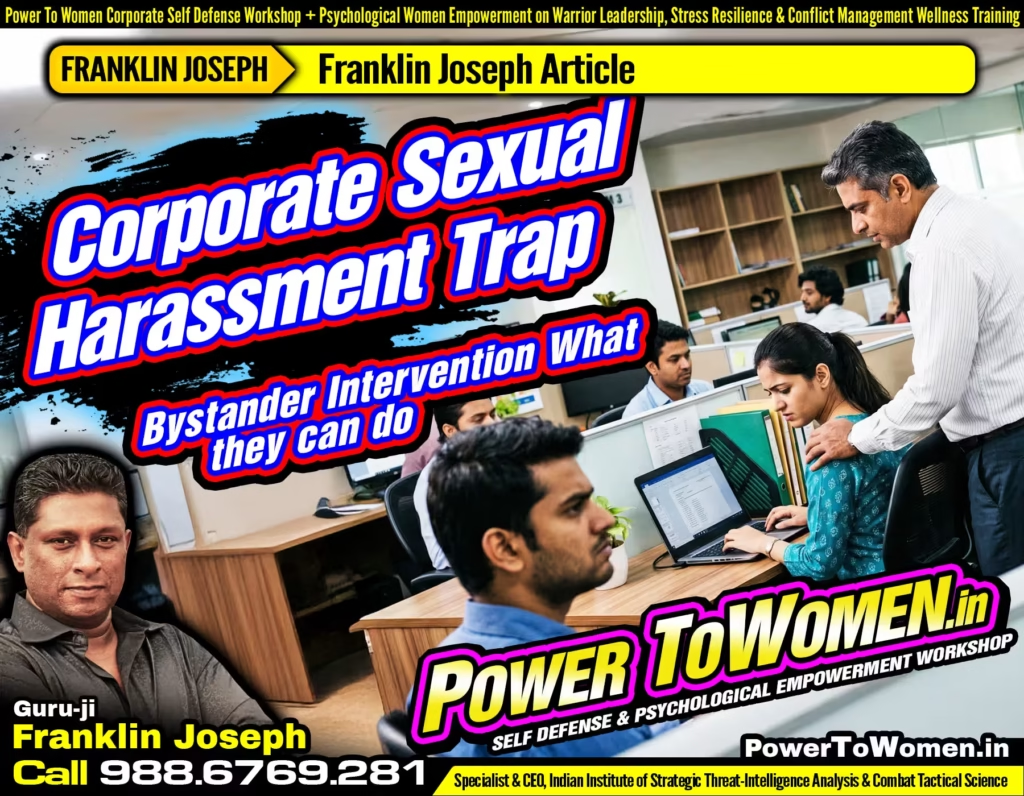
Franklin Joseph Article > Bystander Intervention in Corporate Sexual Harassment ~ What Colleagues Can Do When They Witness Harassment at Work

Ms. Priyamvada Advocate – Krav Maga Self Defence Training Impact on her Solo Travel Safety ~ Professional Women’s Transformation Through Corporate Empowerment Workshop
About Specialist Franklin Joseph