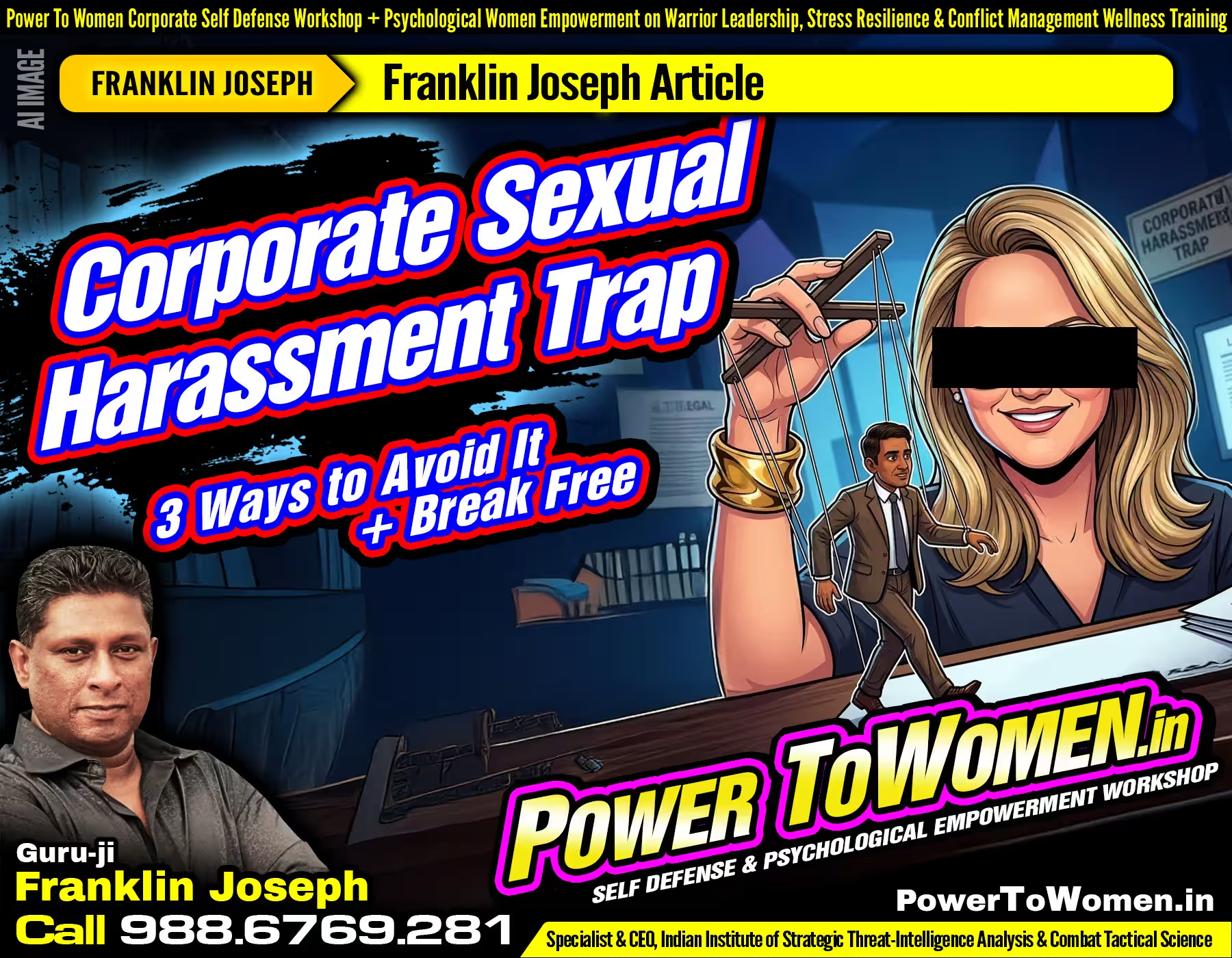





















3 Psychological Ways to Avoid & Break Corporate Sexual Harassment Trap
By Specialist Franklin Joseph | Power To Women Corporate Self Defense Workshop | Franklin Joseph Krav Maga Bengaluru
This blog uses the JPMorgan Chase sexual harassment case (April 2025) as a real-world case study. The accused, Lorna Hajdini, has denied all allegations. The victim, identified as “John Doe,” has filed a civil lawsuit. This article does not adjudicate the case. It uses the publicly reported allegations as a teaching framework for corporate psychological safety.
What the JPMorgan Sexual Harassment Case Tells Every Working Professional in India
A senior banker at one of the most powerful financial institutions in the world. A junior colleague. A complaint filed. A denial issued. A person who reportedly cried during the assault, could not find another job, and is now seeking damages for lost earnings, emotional distress, and reputational harm.
This is not a Hollywood film. This is a filed lawsuit in the New York County Supreme Court, April 2025.
And before you say “this happens in America, not here,” open any Karnataka or Maharashtra newspaper from last week and count how many similar complaints were buried on page seven.
“Criminals do not care about your gender, your job title, or your reputation. They study your access points, your fears, and your silence. The corporate predator does the same thing with a business card.”
– Specialist Franklin Joseph, Bengaluru
According to the allegations in the lawsuit, the harassment followed a pattern that Specialist Franklin Joseph’s training has identified as a Pre-Crime Sequence. It did not begin with violence. It began with a dropped pen, a rubbed leg, a comment about basketball. It progressed through drink invitations, explicit verbal threats, career ultimatums, and racial slurs. By the time the alleged assault occurred, the victim had already been psychologically cornered for months.
That cornering is the trap. And traps do not spring shut on you. You walk into them one step at a time, because no single step looked dangerous enough to stop.
Understanding the Symptoms: What the Victim in This Case Actually Experienced
Before giving you the three ways to avoid this trap and three ways to exit it, you need to understand what happens inside a person who is being subjected to workplace sexual coercion. The lawsuit describes several symptoms that are textbook trauma responses. These are not signs of weakness. They are signs that the nervous system is under attack.
Symptom 1: The Freeze Response
The victim reportedly submitted to encounters despite being reluctant and protesting. His protests were allegedly heard by someone in an adjacent room. This is not consent. This is a trauma freeze, the same neurological shutdown that happens during a physical ambush. When the brain cannot calculate a safe exit, it stops fighting and goes still. In a corporate context, the freeze is engineered through professional leverage, not a physical grip.
Symptom 2: Crying During the Encounter
Read Franklin Joseph Corporate Women Empowerment / Self Defense ArticlesCall 9886769281 for Corporate WorkshopsThe lawsuit alleges the victim cried during at least one incident and was mocked for it. Crying is the body releasing an overwhelming emotional load it cannot process in any other way. It is an involuntary physiological response to violation, not a choice. In the brain’s stress hierarchy, when fight and flight both fail, the body defaults to freeze and then releases through tears. This is biology, not fragility.
Symptom 3: Physical and Physiological Shutdown
Male Victim: The victim in the JPMorgan case reportedly could not achieve an erection during the coerced encounter and was verbally abused for it. This is a well-documented psychosomatic response to sexual trauma. Fear, humiliation, and shock suppress the autonomic responses required for sexual function. The harasser’s abuse of this response was itself a further act of psychological violence designed to shame him into silence.
Female Victim: Female victims often experience dissociation, vaginismus (involuntary muscle spasms causing physical pain), or a complete autonomic nervous system shutdown resulting in physical numbness. The body physically rejects the trauma, even if the victim is forced to comply due to professional coercion or the freeze response. This physiological resistance is often weaponised by the harasser to induce guilt, confusion, or feelings of inadequacy.
Symptom 4: Professional Paralysis
According to the lawsuit, the victim filed an internal complaint in May 2025, which the bank investigated and dismissed. He is now unable to find another job. This outcome, the career destruction without the perpetrator facing consequence, is one of the primary reasons victims stay silent. The fear of exactly this ending silences thousands of complaints every year.
Symptom 5: Delayed Reporting
The alleged harassment reportedly began in the spring of 2024. The complaint was filed internally in May 2025 and the lawsuit in April 2025. That is approximately one year of sustained abuse before formal action. Delayed reporting is not a sign that the allegation is false. It is a sign that the victim spent a year calculating whether reporting was survivable. Most decide it is not. This person decided it was. That decision took everything he had.
“The question is never ‘why didn’t they report it earlier.’ The question is ‘what kind of environment made reporting feel more dangerous than staying silent.’ If your company has created that environment, the harassment is already winning.”
– Specialist Franklin Joseph, Power To Women Corporate Workshop
Part One: Three Psychological Ways to Avoid the Corporate Sexual Harassment Trap
The trap in this case was built slowly, deliberately, and in plain sight. Every step had a professional cover. A dropped pen. A drink after work. A feedback meeting. The harasser was not operating blindly. She was, according to the allegations, reading him, testing him, and advancing only when he did not push back hard enough to create a risk for her.
That is exactly how predatory behavior works in both the street and the boardroom. It seeks the path of least resistance. Your job is to make sure you are not that path.
Psychological Way 1 to Avoid the Trap: Learn to Read the Pre-Crime Sequence Before It Becomes the Crime
What Is the Pre-Crime Sequence in a Corporate Setting?
In street crime, a predator studies your routine, tests your awareness, and strikes when you are most vulnerable. In a corporate setting, the predator does the same thing with performance reviews, one-on-one meetings, after-work invitations, and personal comments about your appearance or relationships. Each step is a test. If you pass it without pushing back, the next test comes a little further across the line.
What the Pre-Crime Sequence Looks Like
In the JPMorgan case as alleged, the sequence reportedly included a deliberate physical touch disguised as an accident (dropping a pen), a sexually explicit verbal comment immediately following that touch, escalating drink invitations, and eventually explicit verbal threats. Each one of those steps was a checkpoint. If the boundary had been named at the first touch and the comment immediately, out loud and professionally, the sequence would have needed to reset. Most harassers do not persist when their first moves are cleanly and calmly named.
How to Apply This Skill
The moment a superior makes a physical contact that feels wrong, a comment that crosses a professional line, or an invitation that feels like a test of your personal compliance, name it. Not aggressively. Not with accusation. Simply name it calmly and professionally in that moment. “I want to keep our working relationship strictly professional” is a sentence that costs you nothing and costs the harasser their test result. It signals that you are paying attention and that you will document what you see.
“The first boundary crossed without consequence is the harasser’s green light. They are not looking for your permission. They are looking for your silence. Silence is a yes in their language.”
– Specialist Franklin Joseph, Bengaluru
Psychological Way 2 to Avoid the Trap: Never Allow Isolation to Become a Habit
Why Isolation Is the Harasser’s Most Important Tool
Read Franklin Joseph Corporate Women Empowerment / Self Defense ArticlesCall 9886769281 for Corporate WorkshopsEvery escalation in the alleged JPMorgan sequence reportedly occurred in private. The drink invitation was designed to move the interaction away from the office. The incident at the victim’s apartment was a private setting. The adjacent room witness was apparently unplanned. Harassers understand that what happens in isolation has no witness, no documentation, and no corroboration. Isolation is not convenience for them. It is operational necessity.
How Isolation Is Engineered Professionally
It is often presented as mentorship, as a special opportunity, as a casual conversation that is too informal for the conference room. “Let’s grab a coffee and talk about your performance.” “Come see me after the others leave.” “I’ll explain the deal structure better over drinks.” Each of these is a normalised professional frame wrapped around an isolating move.
How to Apply This Skill
Create a professional norm for yourself: all substantive work discussions happen in settings where other people are present or where a written record exists. If a meeting needs to happen one-on-one, make sure it is in a glassed-in room, or that you send a written follow-up email immediately after summarising what was discussed. “As we discussed today, here are the key points from our meeting…” creates a paper record of every interaction. The harasser’s power depends on no record existing. Your protection depends on records existing.
Psychological Way 3 to Avoid the Trap: Build Your Evidence Wall Before You Need It
Why Documentation Decides Everything
In the JPMorgan case, the bank’s investigation reportedly concluded there was no merit to the claims, in part because the complainant did not participate in the investigation. Whether that is fair or not, it illustrates the core reality of workplace harassment complaints: they come down to documented evidence versus verbal denial. The person with documentation wins more often than the person without it.
What an Evidence Wall Contains
An Evidence Wall is a private, timestamped, detailed log of every incident that makes you uncomfortable. It includes the date, time, location, exact words used as best you can recall them, any witnesses present, and any physical evidence such as messages, emails, or meeting calendar entries. You do not build this wall after the situation has escalated. You build it from the first uncomfortable moment. If nothing comes of it, you have wasted nothing. If something comes of it, you have saved everything.
How to Apply This Skill
Keep a private document outside company systems, in a personal email or a personal notebook. Record every incident within 24 hours while the details are clear. Save every message, every meeting invite, every email where something felt wrong. If you receive a verbal threat, follow it up in writing: “I wanted to make sure I understood you correctly when you said…” You are not being paranoid. You are operating with the same discipline a soldier uses when they know the terrain is hostile. They do not wait to be attacked before they study the map.
“In crime, the attacker has a plan and the victim has shock. In corporate harassment, the harasser has a pattern and the victim has silence. Documentation breaks that advantage in half. It gives you a plan when the attack finally arrives.”
– Specialist Franklin Joseph, Power To Women Corporate Workshop
Part Two: Three Psychological Ways to Break Free If You Are Already Inside the Trap
Not every person reads the warning signs in time. Not every workplace makes it easy to push back early. And in some cases, the power imbalance is so significant that even the most aware person can find themselves inside the trap before they fully understood how they got there.
If you are already inside, the game changes. But it does not end. The exit exists. It requires a different set of psychological skills.
Psychological Way 1 to Break Free: Use the Strategic No and Put It in Writing
Why the Verbal No Alone Is Not Enough Inside the Trap
The victim in the JPMorgan case reportedly refused invitations verbally. He was reportedly threatened in return. His verbal no was heard and overridden by professional leverage. A verbal no in isolation gives you nothing to stand on legally and nothing to show an investigator. It is your word against theirs and they outrank you.
What a Strategic No Looks Like
A Strategic No is a refusal that creates a written record of both the demand and your refusal. It does not have to name the harassment directly at first. It simply has to exist in writing. If you are invited to a private setting that feels wrong, decline by message: “I am not available for that meeting. Can we schedule something in the office instead?” If a comment is made that crosses a line, follow up by email: “I wanted to follow up on our conversation today. I would prefer to keep our interactions focused on work.” You are not accusing. You are documenting your professional boundary in a format that timestamps it and puts it in writing.
Escalating the Strategic No When Threats Are Made
Read Franklin Joseph Corporate Women Empowerment / Self Defense ArticlesCall 9886769281 for Corporate WorkshopsIf you receive a threat, whether explicit as alleged in the JPMorgan case or implied, document it immediately. Write down the exact words, the date, the time, and the setting. If it came via message, screenshot it. If it was verbal, send a follow-up message: “I wanted to make sure I understood what you said in our meeting today.” That follow-up, if left uncontested, becomes a record. If they contest it, their denial also becomes a record. Either way, you have forced the interaction into a documented space where their power to operate in silence is reduced.
Psychological Way 2 to Break Free: Report Strategically, Not Emotionally
Why Emotional Reporting Fails and Strategic Reporting Survives
The instinct when you are being violated is to report everything at once, with full emotional disclosure, to whoever will listen. This is understandable. It is also often counterproductive. Emotional reporting without documentation is easier to dismiss. It is easier to frame as a misunderstanding or an interpersonal conflict. It gives the investigator nothing concrete to act on.
How to Report Strategically
Before reporting, organise your Evidence Wall into a clear, chronological written statement. Include dates, exact words, locations, and any witnesses. Submit this in writing, not just verbally. Follow up every verbal conversation with a written summary email: “As I reported today to HR, I wanted to provide a written summary of the incidents…” Keep copies of everything you submit outside company systems. If the internal process fails, you have a complete documented record to take to an employment lawyer or a civil court.
Who to Report to and in What Order
Female Victim: In India, female professionals are protected under the POSH (Prevention of Sexual Harassment) Act. You should begin by reporting to the company’s Internal Complaints Committee (ICC), which has statutory authority to investigate and mandate action. The POSH framework provides a structured legal pathway within the corporate system that specifically addresses violence against women in the workplace.
Male Victim: The POSH Act in India currently does not provide statutory protection for men. Male victims must rely on gender-neutral corporate policies, if the company has adopted them, and report to HR. Because there is no specific statutory committee for men, if the internal process fails or dismisses the claim (as allegedly happened in the JPMorgan case), the primary recourse is consulting an employment lawyer and filing a civil lawsuit for coercion, emotional distress, and reputational harm. This makes maintaining a flawless Evidence Wall even more critical for male professionals.
“You cannot fight a battle with no ground under your feet. Documentation is your ground. Reporting strategy is your formation. Before you go into that meeting with HR, you need to know exactly what you are carrying in and exactly what you are asking for. Walk in prepared, not just in pain.”
– Specialist Franklin Joseph, Bengaluru
Psychological Way 3 to Break Free: Rebuild Your Identity Before They Finish Destroying It
What Sustained Workplace Harassment Does to Your Sense of Self
The most damaging part of the alleged abuse in the JPMorgan case is not any single incident. It is what reportedly happened over the full span of months, the racial slurs, the career threats, the sexual humiliation, the mockery of crying, the attack on family. Each of those individual acts was designed to do one thing: convince the victim that they were worthless, unbelievable, and powerless. That tears proved weakness. That physical trauma responses proved compliance. That background made them replaceable. That no one would believe them.
This is psychological warfare. It is as deliberate as any physical attack. And it works. The lawsuit states that the victim is still unable to find another job, long after the incidents occurred. The psychological damage outlasted the harassment itself. It always does when it goes unaddressed.
What Rebuilding Identity Looks Like
The Warrior Mindset framework taught in Specialist Franklin Joseph’s training identifies this as the most critical phase of recovery: separating what was done to you from who you are. Your tears during an assault are not your identity. Your freeze during a threat is not your identity. Your physiological responses during coercion are not your identity. These are biological reactions to an attack. They are evidence of what was done, not evidence of who you are.
Rebuilding begins with naming what happened accurately. Not “I had a difficult relationship with my manager.” Not “things got complicated at work.” What happened, if the allegations are true, is that a more powerful person used professional leverage to coerce sexual compliance from a less powerful subordinate, used slurs to reinforce their sense of worthlessness, and has continued to face no professional consequence while the victim faces ongoing career and personal damage. Naming it accurately, even just to yourself in private, removes the shame from the victim and places it where it belongs.
The Role of a Trained Support Structure
Specialist Franklin Joseph’s Power To Women Corporate Workshop addresses this directly: the difference between a person who survives a trauma intact and a person who is destroyed by it is not the severity of the trauma. It is whether the person had a framework to process it and a support structure to hold them while they did. That framework does not have to be expensive therapy. It starts with one person, whether a trusted colleague, a family member, or a professional counsellor, who can be told the truth without judgment. Truth spoken aloud to a safe witness has a physiological effect. It begins to dissolve the shame and isolation that the harasser depends on to maintain their hold.
Read Franklin Joseph Corporate Women Empowerment / Self Defense ArticlesCall 9886769281 for Corporate Workshops“When someone attacks your identity through harassment, their goal is to make you feel like you deserved it. Like you invited it. Like you are too small, too weak, too nobody to be believed. Your job, once you are out of the immediate danger, is to dismantle that lie the same way you would dismantle any other trap: methodically, carefully, and with evidence. The first piece of evidence is this: you survived. That is a warrior quality. Do not let them take that from you.”
– Specialist Franklin Joseph, Bengaluru
The Racial Harassment Dimension: When Harassment Intersects With Discrimination
The JPMorgan case is not only a sexual harassment case. It is also an alleged racial harassment case. The slurs reported in the lawsuit, including “Brown boy Indian” and the attack on the victim’s wife using racially charged language, represent a second axis of attack: identity destruction through ethnicity.
For Indian professionals working in global financial institutions, law firms, tech companies, and multinational corporations, this dimension is not theoretical. The combination of sexual coercion and racial undermining creates a compound trap. The racial element adds an additional layer of “who will believe me” paralysis, particularly when the harasser belongs to a group that holds more institutional credibility in that setting.
How Racial Harassment Works as a Power Tool Inside the Trap
Male Victim: In the context of the alleged harassment, the racial slurs served a specific function. They were strategic reinforcement of the professional threat. “You think management wants some Brown boy Indian leading originations?” was designed to emasculate him and convince him that his race made him replaceable, that his career existed only at the harasser’s discretion, and that the institutional power structure would side with her by default.
Female Victim: For women, racial harassment often intersects aggressively with misogyny. The intimidation tactic frequently involves fetishization, “exoticization,” or aggressively questioning her professional competence. A female victim might face slurs that imply her career progression is tied only to her physical appearance or cultural stereotypes, doubling the psychological manipulation and marginalizing her within the corporate hierarchy.
How to Counter the Racial Intimidation Tactic
Document the racial language with the same precision you apply to the sexual harassment documentation. In India, workplace racial and caste-based discrimination can constitute additional grounds for civil action even when the POSH framework does not apply to male victims. In international contexts, racial slurs accompanying sexual coercion strengthen both the employment discrimination claim and the civil damages claim significantly. The combination is not just morally egregious. It is legally significant.
What This Case Means for Every Indian Professional Right Now
This case happened in New York. The legal framework is American. But the psychological architecture of the trap, the isolation, the professional leverage, the racial undermining, the shame, the silence, the delayed reporting, the career destruction without consequence for the perpetrator, is not American. It is universal.
Specialist Franklin Joseph’s Power To Women Corporate Workshop operates on a single foundational principle: harassment in a corporate environment follows the same structure as crime in a physical environment. It studies your vulnerability, tests your boundaries, exploits your silence, and expands into whatever space you leave unprotected.
The corporate self-defense response does not require you to throw a punch. It requires you to build situational awareness, set documented professional boundaries, create evidence before you need it, report strategically rather than emotionally, and refuse to let the harasser define who you are by what they did to you.
“There is a soldier who came back from war and cannot sleep for ten years. And there is a soldier who came back from war and eventually sleeps again. The difference is not what happened on the battlefield. The difference is whether someone gave them a framework to process it and a community to carry it with them. Corporate sexual harassment is a battlefield. You need a framework. You need community. That is what this training exists to provide.”
– Specialist Franklin Joseph, Power To Women Corporate Workshop, Bengaluru
Quick Reference Summary: The 3 Ways to Avoid and 3 Ways to Break Free
3 Psychological Ways to Avoid the Corporate Sexual Harassment Trap
Avoid Way 1: Read the Pre-Crime Sequence Early
Learn to identify deliberate boundary testing disguised as professional or social interaction. Name the first boundary violation calmly and professionally. Silence at step one becomes permission at step ten.
Avoid Way 2: Never Allow Isolation to Become a Habit
Create a professional norm of documented interactions. Keep records of all one-on-one meetings. Avoid private settings with someone whose behavior has already crossed a line. The harasser’s power depends on no witness and no record.
Avoid Way 3: Build Your Evidence Wall Before You Need It
Start a private, timestamped log of uncomfortable incidents from the first occurrence. Save messages, emails, and calendar entries. Document in writing within 24 hours of each incident. Your Evidence Wall is your legal foundation if the situation escalates.
3 Psychological Ways to Break Free If You Are Already Inside the Trap
Break Free Way 1: Use the Strategic No in Writing
Verbal refusals leave no record. Decline problematic invitations by message. Follow up verbal incidents with email summaries. Force every interaction into a documented format where the harasser’s behavior is on the record.
Break Free Way 2: Report Strategically, Not Just Emotionally
Organise your Evidence Wall into a written chronological statement before reporting. Submit everything in writing. Keep copies outside company systems. Follow up verbal HR conversations with email summaries. Know your legal standing (POSH Act for women; gender-neutral policies and civil action for men) before you report.
Break Free Way 3: Rebuild Your Identity Before They Finish Destroying It
Name what happened accurately. Separate physiological trauma responses (freeze, crying, dissociation, inability to perform) from your identity. Tell the truth to one safe, trusted person. Access a professional support framework. The harasser’s final tool is your shame. Take that tool away from them.
About the Power To Women Corporate Self Defense Workshop by Specialist Franklin Joseph
The Power To Women Corporate Self Defense Workshop is Bengaluru’s premier corporate safety programme, rated 4.9 stars and trusted by Fortune 500 clients including Google, Amazon, DRDO, Goldman Sachs, and the Israeli Consulate General of South India.
Created by TEDx Speaker and Israeli Military Krav Maga Specialist Franklin Joseph, with over two decades of experience training NSG Black Cat Commandos, IAS, IPS, and IRS officers, the workshop delivers real-world psychological self-defense skills to corporate employees without any physical combat drills.
The programme covers Pre-Crime Indicator Recognition, Verbal Modulation, Violence De-Escalation, Threat Perception, Predator Selection Criteria, Evidence Wall Building, Strategic Reporting, and Identity Rebuilding after psychological attack.
Whether you are an HR leader looking to strengthen your POSH framework with practical psychological skills, a company looking to genuinely protect your employees beyond compliance training, or an individual professional who wants to understand how workplace predators operate and how to stop them, this workshop delivers the knowledge that changes outcomes.
Contact Specialist Franklin Joseph
Call or WhatsApp: 9886769281
Website: PowerToWomen.in
Training locations: Bengaluru, Dharwad, Hubballi, Mysuru, Chennai, Hyderabad, Mumbai, Delhi, Pune, Goa, and across India on request.
“The victim in this case asked every company he applied to for a second chance at a career. He did not get it. The perpetrator is reportedly still employed. I am not in a position to change what happened in New York. But I am in a position to make sure that the person reading this article knows exactly what to do so that they never end up in that position. That is why this training exists. That is why this article was written. Prepare now. Not after.”
– Specialist Franklin Joseph, Bengaluru
Corporate Self Defence Workshops ~ 'Embrace Inner Power'
Our all-encompassing strategy combines state-of-the-art Israeli Military Krav Maga self-defence methods with revolutionary psychological tactics like to help you maintain composure, assertiveness, and control whether you're negotiating a high-pressure boardroom or an unpredictable street or domestic encounter. Don't hesitate; give Specialist Franklin Joseph a call @ 9886769281 right now to learn the most important skills and become a part of the movement towards empowered life.
Connect with Specialist Guruji Franklin Joseph for
Women Emergency All State Helpline Directory Guide
PDF - Click to Download India State-Wise Women Emergency Helpline DirectoryARTICLE - Read Online Basic Corporate Self-Defense & Women Emergency Resource Guide

Corporate Workshops Clients
Other Posts & Articles

Quest towards a Warrior Mindset – Ms. Priyamvada, Advocate
About Specialist Franklin Joseph