



















Last updated on February 25th, 2026 at 09:41 am
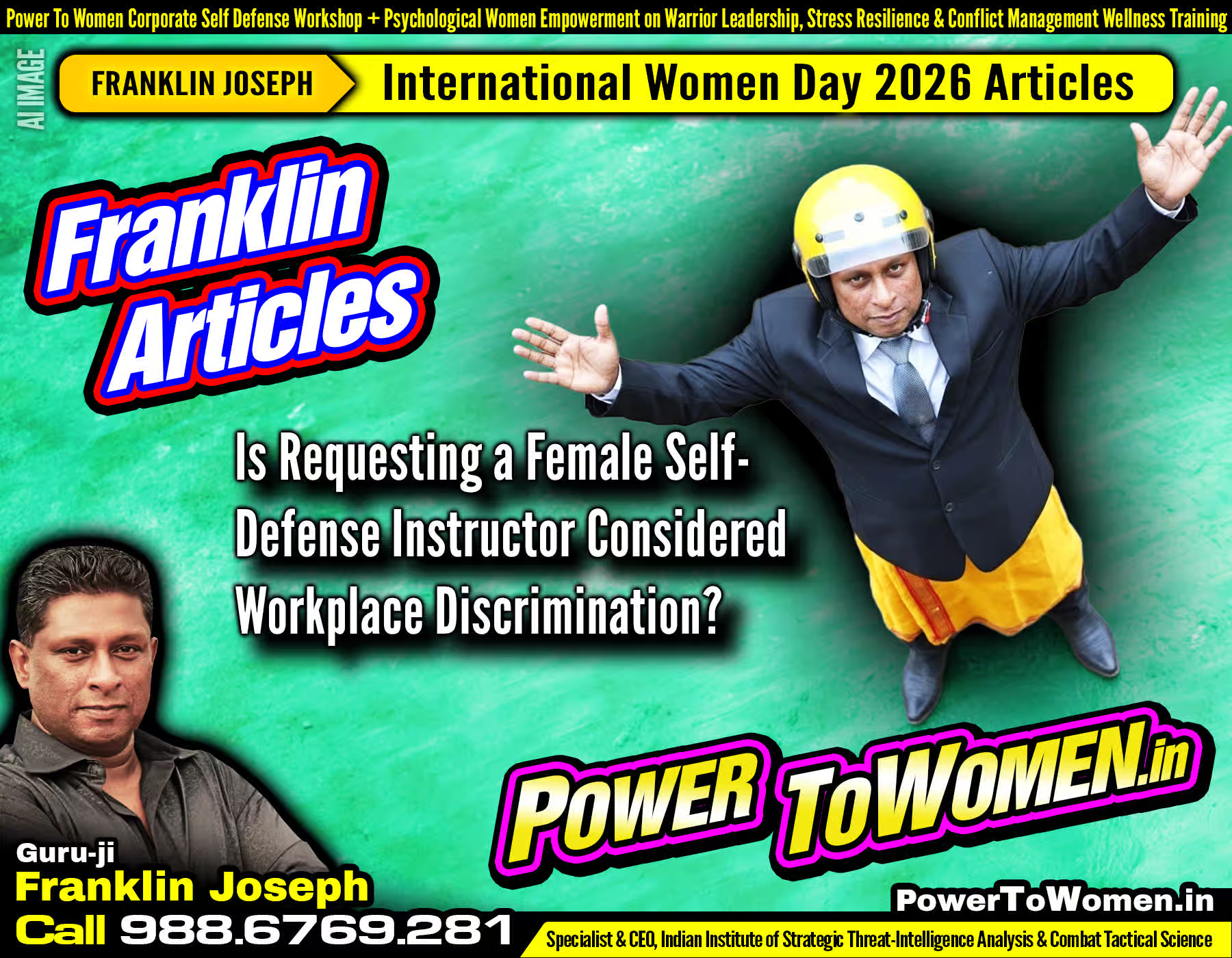
Is Requesting a Female Self-Defense Instructor Considered Workplace Discrimination?
By Specialist Franklin Joseph | Power to Women Corporate Self-Defense Workshop
Gender-Based Instructor Selection in Corporate Self-Defense: A Question Most HR Teams Have Never Examined
Here is something interesting about the way corporate decisions are made. If an HR team received a hiring request that said “only male candidates for this role,” alarm bells would ring immediately. The DEI team would be notified. Legal would weigh in. The request would be rejected or significantly revised.
But when an HR team sends out a training vendor request that says “we prefer a female instructor for our women’s self-defense workshop,” nobody blinks. It goes out as a routine email. The assumption is that this is a thoughtful, employee-friendly decision.
The question is: why does the same type of gender-based specification trigger very different reactions depending on the context? And the follow-up question is: should it?
I believe the answer is no. And I think once you look at this issue clearly, you will see why.
The Power to Women Self-Defense Workshop was built by merging two critical disciplines that most programs treat as entirely separate: the battle-tested tactical framework of Israeli military Krav Maga self-defense and a deep layer of psychological conditioning skills drawn from crisis behaviour science. The result is a system that goes far beyond teaching physical moves. It is scientifically designed to help women prevent, avoid, diffuse, and escape crime across every phase of a threat, not simply react once an assault has already begun.
The psychological architecture embedded within the program includes:
- Pro-Active Combat Science: Training participants to seize control of a confrontation from its opening second, rather than surrendering the initiative to the aggressor.
- Guerrilla Hit and Run Deception: Studying the ambush methods that predators rely on and repurposing them as tools of escape and counter-action.
- Neuro-Behavioral Crisis Management: Building a brain that performs under life-threatening pressure instead of shutting down into helplessness.
- Warrior Mindset: Developing the internal psychological framework that draws the line between those who are targeted and those who act with decisive purpose.
- Fear Counterinsurgency: Intercepting the chemical flood of panic and redirecting it into focused, usable tactical energy.
- Pro-Failure Conversion Technique: Capturing every training error and transforming it into a data point that strengthens the next response.
- Critical Decision Life Safety Skills: Forging the capacity to select the correct action in the compressed moment where delay translates into damage.
- Psychological Anti-Stress Conditioning: Installing composure under chaos as a practised, repeatable capability rather than an innate personality trait.
- Dynamic Scenario Analysis Strategy: Developing the ability to interpret rapidly shifting danger signals as they unfold in real-world conditions.
- Pre-Conflict Situational Awareness: Sharpening perception to detect danger while it is still gathering shape, well before it becomes a visible incident.
- Threat Perception: Training the senses to register predatory intent through body language and environmental signals before any weapon is produced or any overt threat is declared.
- Post-Battle Quick Response: Preparing for the critical half-minute immediately after violence, a window that frequently determines whether a survivor reaches lasting safety or faces secondary harm.
- Stealth and Evasive Tactics: Mastering the discipline of neutralising threats by ensuring they never escalate to a physical confrontation.
- Active Warfare Emotional Balance: Preserving cognitive clarity and decision-making accuracy even when the body is saturated with adrenaline.
- Verbal Modulation Instructions: Deploying tone, volume, pacing, and word choice as precision instruments of authority and de-escalation.
- Violence De-Escalation Techniques: Collapsing a threat’s forward momentum through psychological and verbal intervention before any physical contact occurs.
- Crime Radar Deterrence Manoeuvre: Adjusting posture, movement patterns, and environmental awareness so that a predator’s internal targeting system rejects the participant as a viable target.
- Criminal Profiling / Crime Psychology: Mapping how attackers evaluate environments, weigh risks, select victims, and commit to a course of action.
- Pain Compliance / Pressure Methodology: Using precise anatomical knowledge to generate disproportionate defensive effect when physical size and strength are not an advantage.
- Emergency Risk Analysis and Management: Executing high-stakes decisions in compressed time frames where every second carries life-altering consequences.
- Decrypting Pre-Crime Sequence: Identifying the brief, often invisible behavioural cues that appear in the one-to-three seconds before an attack is launched.
This depth of tactical and psychological integration is the standard against which every hiring decision discussed in this article should be measured. When a program is built on this foundation, the only question that matters about the instructor is whether they possess the expertise to deliver it.
What Is Workplace Discrimination: Legal Definition and How It Applies to Self-Defense Instructor Selection
Workplace discrimination, in its simplest form, is treating a person differently in a professional context based on a characteristic that has no bearing on their ability to do the job. When that characteristic is gender, it is gender-based discrimination.
Let us apply that definition to the scenario at hand.
Read Franklin Joseph Corporate Women Empowerment / Self Defense ArticlesCall 9886769281 for Corporate WorkshopsA company needs a self-defense instructor. The job requires expertise in crime psychology, personal safety methodology, communication skills, and the ability to create meaningful behavioural change in participants. These are the competencies that determine whether the training will be effective.
Now, the company adds one more requirement: the instructor must be female.
Is gender a competency? Does being female make someone inherently better at teaching crime awareness, threat response, or freeze management? Does being male make someone inherently incapable of teaching these subjects?
The answer to all three questions is no. Which means that gender, in this context, is a characteristic that has no bearing on the ability to do the job. And specifying it as a requirement meets the definition of discrimination.
“Discrimination is not defined by its intention. It is defined by its structure. When you exclude a professional from a job based on a characteristic that has nothing to do with that job, the structure is discriminatory. No matter how kind the intention behind it.”
– Specialist Franklin Joseph
The Gender Flip Test for Self-Defense Instructor Hiring: Why the Same Logic Must Apply in Both Directions
I find that the simplest way to test whether a decision is discriminatory is to flip the genders and see how it sounds.
Original statement: “We want a female self-defense instructor because our women employees will feel more comfortable.”
Flipped statement: “We want a male leadership trainer because our male employees will feel more comfortable.”
The second statement sounds immediately problematic. It sounds regressive. It sounds like something from a workplace culture that has not evolved. No modern HR professional would approve it.
But the logic is identical. The reasoning is identical. The only difference is which gender is being specified. And if the flipped version is unacceptable, the original version should be held to the same standard.
Equality means applying the same rules regardless of which gender is involved. If a gender specification is wrong in one direction, it is wrong in both directions. That is not a radical position. That is the basic definition of equality.
Indian Laws on Gender Discrimination in Trainer and Vendor Selection: Constitution, POSH Act, BFOQ, and More
Let me walk through the relevant legal framework, because I think many HR professionals will find this eye-opening.
Constitutional Protection Against Sex-Based Discrimination in Professional Engagement
Articles 14, 15(1), and 16 of the Indian Constitution collectively establish that no person should face discrimination based on sex in matters of equality, opportunity, or employment. While these articles directly address state action, Indian courts have progressively applied their underlying principles to private sector employment practices, particularly through judicial interpretations that recognise the constitutional right to equality as a pervasive standard.
Equal Remuneration Act and Code on Wages: Gender-Neutral Recruitment Standards
Read Franklin Joseph Corporate Women Empowerment / Self Defense ArticlesCall 9886769281 for Corporate WorkshopsSection 5 of the Equal Remuneration Act, 1976 explicitly prohibits discrimination in recruitment for the same or similar work. Section 3 of the Code on Wages, 2019 reinforces this. The consistent legal message is that professional engagement should be based on competence, not on gender.
POSH Act Trainer Requirements: Why the Law Does Not Mandate Gender-Specific Instructors
This is worth emphasising because it is a common misconception. The POSH Act requires workplace safety awareness and training. It does not, anywhere in its text, specify that such training must be delivered by a person of a particular gender. The Act focuses on content quality, organisational compliance, and outcomes. The Act also exists to dismantle gender stereotyping in the workplace. Insisting on a female trainer based on gendered assumptions about comfort actually contradicts the Act’s objectives.
Why BFOQ (Bona Fide Occupational Qualification) Does Not Justify Gender-Based Instructor Selection
The Bona Fide Occupational Qualification exception allows gender to be a requirement only when it is genuinely essential to the nature of the work. Examples include same-gender intimate care providers and actors for gender-specific roles. Teaching self-defense is a knowledge-based profession where the instructor’s gender has no impact on their ability to deliver the service. BFOQ does not cover this scenario.
Corporate DEI Policy Conflicts When Specifying Trainer Gender
Most corporates with formal DEI policies include language prohibiting gender-based discrimination in all forms of hiring and engagement. A requirement specifying a female-only trainer creates a direct conflict with these policies. If the DEI policy is meaningful, it should apply consistently across all engagement decisions, including vendor and trainer procurement.
Discriminatory Procurement: How Gender-Based Vendor Exclusion Violates Corporate Governance and ESG Standards
Here is an angle that rarely gets discussed but is legally significant.
When a company issues a service requirement that excludes professionals based on gender, it is not just making a training decision. It is making a procurement decision. And procurement decisions are subject to fairness, transparency, and non-discrimination standards under corporate governance frameworks.
Under the Companies Act, 2013 and SEBI’s corporate governance guidelines, companies are expected to conduct their operations, including procurement, with integrity and without arbitrary discrimination. A gender-based exclusion in vendor selection, when gender is not a genuine occupational requirement, is difficult to justify under these standards.
For companies that report under ESG frameworks, the Social component specifically assesses equal opportunity and non-discrimination across all business operations. Gender-based vendor exclusion can be flagged as an inconsistency during ESG audits or stakeholder reviews.
Internationally, ILO Convention No. 111 (ratified by India) prohibits sex-based discrimination in employment and occupation. CEDAW (also ratified by India) specifically addresses gender stereotyping. The UN Guiding Principles on Business and Human Rights expect businesses to respect the right to non-discrimination in all their operations.
Why the Comfort Argument Fails: Professional Expertise Creates Training Safety, Not Instructor Demographics
Most companies justify the female instructor requirement using a single argument: comfort. “Our women employees will feel more comfortable with a female instructor.”
Let us examine this argument practically.
The women in your organisation handle complex negotiations with male clients. They work under male supervisors. They collaborate with male colleagues. They attend conferences led by male speakers. They consult with male doctors, male lawyers, and male financial advisors. In none of these situations does comfort based on the other person’s gender become a deciding factor.
Read Franklin Joseph Corporate Women Empowerment / Self Defense ArticlesCall 9886769281 for Corporate WorkshopsWhy is a self-defense workshop different? What is it about this particular context that suddenly makes the professional’s gender the most important variable?
The unstated assumption is that self-defense involves physical proximity, body-related topics, or discussions of violence, and that these subjects are somehow too sensitive for a male instructor to handle professionally. But this assumption is not only unfounded, it is itself a form of gender bias. It implies that a professional cannot conduct themselves with sensitivity and expertise around participants based on demographic characteristics. It also implies that participants cannot engage professionally in a structured, supervised environment led by a skilled facilitator.
Both of these implications are problematic. And both undermine the professional capabilities of everyone involved.
The Power to Women framework addresses this directly. Verbal Modulation Instructions trains how voice, tone, and language create trust, establish psychological safety, and maintain control in emotionally sensitive environments. Psychological Anti-Stress Conditioning recognises that composure during difficult conversations about violence and trauma is a professional capability built through years of deliberate practice, not an inherited trait. And Violence De-Escalation Techniques develops the ability to manage tension and reduce emotional escalation in any room through calibrated psychological and verbal skill. A trainer who has mastered these competencies creates safety through expertise, not through demographic identity.
“The comfort argument assumes two things: that certain professionals cannot be empathetic based on their demographics, and that participants cannot be resilient in a professionally facilitated environment. Both assumptions are forms of stereotyping. And both have no place in a modern workplace.”
– Specialist Franklin Joseph
The TEDx Talk Behind the Training: Understanding Specialist Franklin Joseph’s Approach to Crime Prevention and Personal Safety
Specialist Franklin Joseph’s TEDx talk is not a general motivation speech about staying safe. It is a structured, evidence-informed argument about why conventional personal safety training gets the problem wrong and what a psychologically grounded, crime-aware approach looks like when it is built correctly. As a TEDx Speaker with decades in crime psychology, he uses that platform to make a case that most training programs quietly avoid making.
The Power to Women Corporate Self-Defense Workshop is the direct practical application of that case. The workshop’s structure, its emphasis on prevention over reaction, its integration of criminal behaviour science, and its use of psychological conditioning as a core training tool all trace back to the framework Specialist Franklin Joseph outlined on that TEDx stage.
Watch the TEDx talk here: Specialist Franklin Joseph | TEDx Talk on Personal Safety and Crime Psychology
How Gender-Based Trainer Selection Destroys Self-Defense Training Quality: The Tricks Misconception and Why Crime Expertise Matters More
Beyond the legal and ethical dimensions, there is a practical consequence of gender-based trainer selection that directly affects your employees’ safety.
There is a widespread misconception that self-defense is simply about learning a few physical “tricks” to escape a hold. Because of this, there is an assumption that a female instructor is inherently better suited to teach women, simply because she can demonstrate how a woman performs these specific moves. But this mindset dangerously misunderstands the reality of violence.
Most of these physical tricks are purely reaction-based tactics, meaning they only come into play after the crime has already started. Considering the objective reality of biology, the typical size, weight, and strength disparity between a male attacker and a female victim, fighting back physically after an assault has begun is an incredibly difficult path. Real crime is rarely a spontaneous, fair fight. It is mostly planned. Predators carefully choose the ambience, the method of ambush, the potential weapons, and sometimes even involve multiple people.
Read Franklin Joseph Corporate Women Empowerment / Self Defense ArticlesCall 9886769281 for Corporate WorkshopsTherefore, self-defense is not just about learning physical tricks. An instructor’s knowledge of crime psychology, predator tactics, and environmental awareness must far exceed a basic knowledge of martial arts.
When gender becomes the primary filter, competence becomes secondary. Companies end up selecting trainers who meet the demographic requirement but may lack this critical, specialised expertise.
Effective self-defense training covers crime psychology and how criminals select and approach victims. It addresses the freeze response and how to overcome it. It teaches pre-crime awareness skills that prevent most dangerous situations before they escalate. It covers post-incident protocols including legal rights, evidence preservation, and psychological recovery. And it addresses the social conditioning patterns that often prevent women from acting decisively in dangerous moments.
It is not just about learning the tricks. An effective program is scientifically designed to focus on how to prevent crime before it starts, how to avoid dangerous situations through trained awareness, how to diffuse escalating threats through psychological and verbal skill, and how to escape when all other options have been exhausted. An instructor who cannot deliver across all four of these dimensions is offering an incomplete program, regardless of how impressive the physical demonstrations look.
A trainer selected primarily for gender, rather than for this deep level of tactical and psychological expertise, is unlikely to cover all of these vital areas. And a program that misses any of these areas is leaving gaps in your employees’ preparedness. Those gaps do not show up in workshop photographs. They show up in real crisis situations.
This is precisely why the Power to Women program integrates Criminal Profiling and Crime Psychology, giving participants a working model of how a predator scans environments, calculates risk, and decides whether a target is worth pursuing. It builds Pre-Conflict Situational Awareness, the discipline of sensing when a situation is beginning to shift toward danger well before any visible threat emerges. It trains Decrypting Pre-Crime Sequence, teaching participants to identify the brief behavioural signals that flash in the seconds before an attacker commits to action. It develops Neuro-Behavioral Crisis Management, conditioning the brain to execute trained responses under extreme duress instead of shutting down into paralysis. It applies Fear Counterinsurgency, converting the body’s raw panic cascade into controlled, deliberate action. And it incorporates Pro-Active Combat Science, training participants to dictate the terms of any encounter from its first moment rather than waiting to absorb an attacker’s initiative and trying to recover. These competencies cannot be evaluated by checking a demographic box. They can only be evaluated by examining what the instructor knows, what they have built, and what results they have produced.
Merit-Based Self-Defense Instructor Selection: The Right Approach for Legal Compliance, Employee Safety, and Training Quality
The good news is that the right approach is both simpler and more effective than the current one.
Instead of starting with “What gender is the instructor?”, start with “What does this instructor know, and can they prepare our people for real danger?”
Evaluate every potential trainer, regardless of gender, on the exact same criteria of skill and competence:
- Depth of expertise in crime psychology and criminal behaviour patterns.
- Comprehensive coverage of pre-crime, during-crime, and post-crime phases.
- Specific methodology for addressing the freeze response and psychological barriers.
- Scenario-based training grounded in real-world crime data rather than just physical “tricks”.
- Demonstrated professionalism and sensitivity in creating safe learning environments.
- Verifiable track record with corporate clients and documented participant outcomes.
This approach is based purely on skill. It is legally sound. It is consistent with your DEI policy. And it produces better results for the people who matter most: your employees.
When your selection process focuses on tactical and psychological depth, the right questions become clear. Can this instructor deliver Warrior Mindset development, cultivating the internal shift that separates those who hesitate from those who act with purpose when survival demands it? Can they train Guerrilla Hit and Run Deception, reversing the asymmetric ambush strategies criminals depend on and converting them into tools of escape? Can they build Dynamic Scenario Analysis Strategy, developing the ability to read and respond to rapidly evolving threats in unpredictable real-world conditions? Can they teach Stealth and Evasive Tactics, the discipline of neutralising dangerous situations without ever engaging in a physical fight the participant was never designed to win? Can they develop Pain Compliance and Pressure Methodology, using precise anatomical targeting to generate maximum defensive effect regardless of the defender’s physical size? Can they apply Critical Decision Life Safety Skills, forging the ability to choose the right action in the fraction of a second where indecision results in injury? Can they train Post-Battle Quick Response, preparing participants for the critical thirty seconds after violence that often determine whether survival holds? Can they build Active Warfare Emotional Balance, preserving clear thinking when adrenaline is overwhelming every system in the body? Can they incorporate Threat Perception, training participants to register hostile intent through subtle environmental and behavioural cues long before any weapon is visible? Can they teach Crime Radar Deterrence Manoeuvre, reshaping how a participant moves through the world so that predators identify her as someone to avoid entirely? Can they apply Emergency Risk Analysis and Management, training split-second decisions in compressed time frames where delay carries irreversible consequences? Can they integrate Pro-Failure Conversion Technique, turning every training error into raw material that sharpens the next response? These are the questions that determine whether a workshop saves lives. Everything else is a distraction from that standard.
“The irony is that by removing the gender filter, you actually improve the quality of your selection. You open yourself up to the full pool of highly qualified professionals instead of artificially limiting it. Better pool. Better choice. Better training. Better safety. It is not complicated.”
– Specialist Franklin Joseph
Final Answer: Is Specifying Female-Only Self-Defense Instructors Workplace Discrimination Under Indian Law?
Is requesting a female self-defense instructor considered workplace discrimination?
If the request excludes a qualified professional from a service engagement based solely on gender, and if gender is not a genuine occupational requirement for the role, then yes, it meets the structural definition of gender-based discrimination. It may not be intended as discrimination. It may come from a place of genuine care. But the structure of the decision, excluding based on gender when gender is irrelevant to professional competence, is discriminatory regardless of intent.
The better path is to make decisions based entirely on skill and expertise, and to trust that your employees are best served by learning from the highest-quality professional available, whoever that professional happens to be.
“Intent does not define discrimination. Structure does. And when the structure says ‘only this gender may apply,’ the intent behind it does not change what it is.”
– Specialist Franklin Joseph
Corporate Self Defence Workshops ~ 'Embrace Inner Power'
Our all-encompassing strategy combines state-of-the-art Israeli Military Krav Maga self-defence methods with revolutionary psychological tactics like to help you maintain composure, assertiveness, and control whether you're negotiating a high-pressure boardroom or an unpredictable street or domestic encounter. Don't hesitate; give Specialist Franklin Joseph a call @ 9886769281 right now to learn the most important skills and become a part of the movement towards empowered life.
Connect with Specialist Guruji Franklin Joseph for
Women Emergency All State Helpline Directory Guide
PDF - Click to Download India State-Wise Women Emergency Helpline DirectoryARTICLE - Read Online Basic Corporate Self-Defense & Women Emergency Resource Guide

Corporate Workshops Clients
Other Posts & Articles

Quest towards a Warrior Mindset – Ms. Priyamvada, Advocate
About Specialist Franklin Joseph