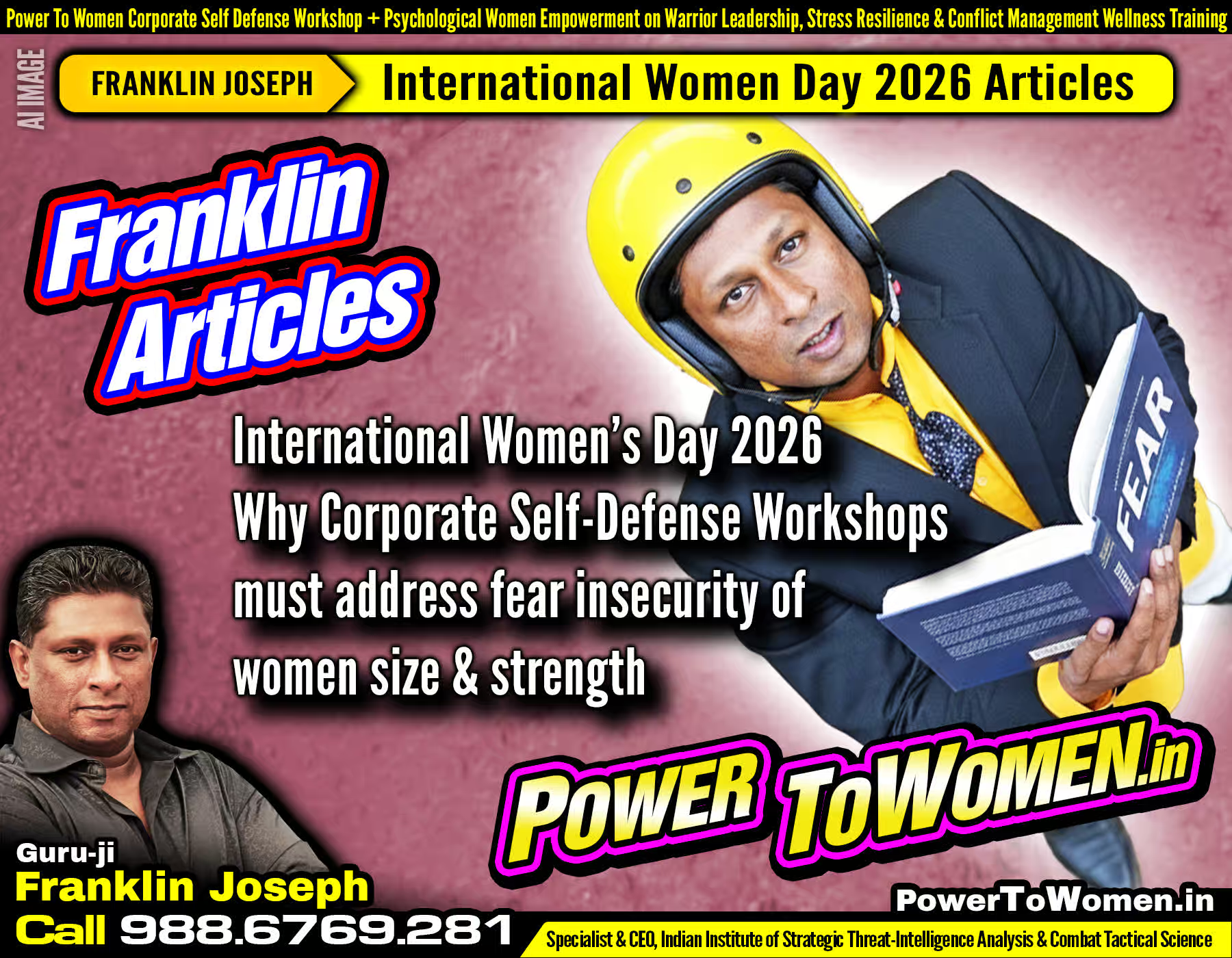




















International Women’s Day 2026: Why Corporate Self-Defense Workshops Must Address Fear and Insecurity of Women About Size and Strength
By Specialist Franklin Joseph | Power to Women Corporate Self-Defense Workshop
Published: March 8, 2026 | Category: Women’s Safety, Corporate Training, International Women’s Day, Psychological Self-Defense
The Unspoken Fear That Undermines Every Women’s Safety Initiative
Every year on March 8th, companies around the world celebrate International Women’s Day with flowers, speeches, and social media posts. Conference rooms are decorated. Inspirational quotes are shared. Women employees receive appreciation messages from leadership.
All of this is wonderful. Recognition matters. Appreciation matters.
But beneath the celebrations, there is a fear that rarely gets addressed directly. It is the fear that lives in the back of every woman’s mind when she walks through a parking lot at night, takes public transport alone, or finds herself in an uncomfortable situation with someone larger and physically stronger than her.
That fear whispers: “I am smaller. I am weaker. If something happens, I cannot fight back. I cannot win.”
This fear is not irrational. It is based on biological reality. On average, men have 40 to 60 percent greater upper body strength than women. They have denser bones, more muscle mass, and larger frames. In a purely physical confrontation based on strength alone, the odds are not equal.
And yet, most self-defense programs ignore this elephant in the room. They teach techniques as if strength differences do not exist. They show moves on cooperative training partners and leave women wondering: “But will this actually work against someone twice my size?”
International Women’s Day 2026 presents an opportunity to finally address this fear honestly. Not by pretending it does not exist. Not by offering false assurances. But by teaching women that size and strength are only two factors among many, and that psychological preparedness, tactical intelligence, and strategic thinking can overcome physical disadvantages in ways that raw strength never could.
The Statistics That Fuel Women’s Fear About Physical Confrontation
Before we can address the fear, we must understand its foundations. The physical differences between men and women are well documented by scientific research, and acknowledging these differences is essential for developing training that actually works.
Understanding the Physical Reality
Research published in the Journal of Applied Physiology and other peer-reviewed sources reveals consistent findings:
- Men have approximately 40 to 60 percent more upper body strength than women on average
- Men have approximately 25 to 30 percent more lower body strength than women on average
- Male grip strength averages 50 percent higher than female grip strength
- Men have greater bone density and larger skeletal frames on average
- Men have higher proportions of fast-twitch muscle fibers, which generate explosive power
- The average man is 12 to 15 centimeters taller than the average woman
- The average man weighs 10 to 15 kilograms more than the average woman
These are not stereotypes. These are measured biological differences that exist across populations. And every woman instinctively knows these differences exist, which is why the fear of physical confrontation is so prevalent.
Why This Fear Is Both Valid and Misleading
Here is where the conversation gets nuanced. The fear that women feel about physical confrontation is valid because it is based on real physical differences. But it is also misleading because it assumes that physical confrontation is a pure strength contest.
Crime is not arm wrestling. It is not a weightlifting competition. The factors that determine outcomes in real-world dangerous situations extend far beyond raw physical strength. And this is precisely what effective self-defense training must address.
Why Traditional Self-Defense Training Fails to Address the Size and Strength Gap
Most self-defense programs make a critical error. They focus almost exclusively on physical techniques while ignoring the psychological reality that makes those techniques difficult or impossible to execute in real situations.
Consider what happens in a typical martial arts based self-defense workshop:
- An instructor demonstrates a technique on a willing partner who does not resist
- Participants practice the move in a controlled environment with cooperative partners
- Everyone leaves feeling good about their new “skills”
- But deep down, many women still wonder: “Would this work against a real attacker who is bigger, stronger, and genuinely trying to hurt me?”
This doubt is not paranoia. It is realistic assessment. And it points to the fundamental flaw in technique-focused training.
The Problem with Reaction-Based Physical Techniques
Most physical self-defense techniques are reaction-based. This means they only come into play after an attack has already begun. The attacker grabs you, and then you respond with a counter-technique.
But here is the problem. Once a larger, stronger attacker has physical control of you, your options become severely limited. The strength differential that women fear becomes most relevant precisely at this moment. Breaking a grip, escaping a hold, or creating distance all require overcoming the attacker’s physical advantages.
This is why so many women leave self-defense workshops feeling uncertain. They learned techniques, but they also know, perhaps without articulating it, that those techniques assume a level playing field that does not exist in reality.
The Martial Arts Myth That Damages Women’s Confidence
There is a pervasive myth in self-defense culture that martial arts training equalizes physical differences. The image of a small person defeating a larger opponent through technique is powerful and appealing. But it is often misleading when applied to women’s self-defense contexts.
Most martial arts were developed for contexts very different from crime survival:
- Sport martial arts operate within rules, weight classes, and refereed matches that do not exist in real attacks
- Traditional martial arts were often developed for battlefield contexts between similarly trained warriors
- Competition-focused training assumes both participants are prepared, warmed up, and mentally ready for confrontation
Crime operates under none of these conditions. The attacker chooses the time, place, and method. There are no rules, no referees, and no weight classes. Techniques that work in controlled environments may fail completely when deployed against a larger attacker who has chosen the moment of attack.
The Fear That Never Gets Discussed
In my decades of conducting corporate self-defense workshops, I have noticed something consistent. When given the opportunity to ask questions privately, women repeatedly express the same concern:
“I understand the technique, but I am small. My attacker will be bigger. How can I possibly overpower someone who is so much stronger than me?”
Read Franklin Joseph Corporate Women Empowerment / Self Defense ArticlesCall 9886769281 for Corporate WorkshopsThis question deserves a direct answer. And the answer is not: “Just hit harder.” The answer is: “You are right. Strength against strength, you will likely lose. Which is exactly why effective self-defense is not about strength at all.”
Understanding Why Size and Strength Are Not the Deciding Factors in Crime Survival
Here is a truth that changes everything: Crime is not a wrestling match. It is not a boxing ring. It is not a controlled environment where the stronger person automatically wins.
Crime is chaos. It is surprise. It is psychological manipulation. It is timing and positioning and deception. And in this arena, size and strength are just two variables among dozens.
What Actually Determines Outcomes in Dangerous Situations
Research into crime survival and violent encounters reveals that physical strength is rarely the determining factor. What matters much more includes:
- Awareness: Did the target see the threat developing before it became physical?
- Psychological preparedness: Did the target freeze, or did they act?
- Decision speed: How quickly did the target assess the situation and choose a response?
- Willingness to act: Did the target overcome social conditioning against confrontation?
- Tactical positioning: Was the target in a position of advantage or disadvantage?
- Element of surprise: Who controlled the element of surprise in the encounter?
- Target selection: Did the target present as an easy victim or a difficult one?
- Environmental factors: Were there escape routes, witnesses, or barriers available?
- Verbal skills: Could the target de-escalate or create hesitation through communication?
- Mental resilience: Did the target maintain cognitive function under stress?
Notice that physical strength does not appear on this list. That is not because strength is irrelevant, but because in real-world crime scenarios, the factors listed above typically determine the outcome long before strength becomes a factor.
How Criminals Actually Select Their Targets
Understanding criminal psychology reveals why size and strength matter less than most women believe.
Criminals do not select targets based on who they can physically overpower. If that were the case, they would target other men, who represent more valuable targets in terms of wallets, watches, and other valuables. Instead, criminals consistently select targets based on perceived vulnerability, which has almost nothing to do with physical size.
Research on convicted criminals reveals that they look for:
- Distracted individuals absorbed in phones or thoughts
- People who appear unaware of their surroundings
- Those who seem hesitant or uncertain in their movements
- Individuals who avoid eye contact and appear submissive
- People in isolated positions without witnesses or help nearby
- Those who appear unlikely to resist or create a scene
- Individuals who seem mentally elsewhere, not present in their environment
A small woman who walks with awareness, makes eye contact, and projects confidence is far less likely to be targeted than a larger woman who appears distracted, uncertain, and vulnerable. Size protects no one. Awareness protects everyone.
The Gait Study: Scientific Evidence That Vulnerability Is About Behavior, Not Size
A landmark study by Grayson and Stein asked convicted criminals to watch video footage of pedestrians and identify which ones they would select as targets. The results were illuminating.
Criminals consistently identified the same individuals as potential targets, regardless of those individuals’ physical size. The factors that made someone appear targetable were behavioral:
- Stride length and walking rhythm
- Body movement coordination
- Head position and eye movement patterns
- Overall projection of confidence or vulnerability
Physical size was not a determining factor. A small woman who moved with purpose and awareness was passed over in favor of larger individuals who appeared distracted or uncertain.
Read Franklin Joseph Corporate Women Empowerment / Self Defense ArticlesCall 9886769281 for Corporate WorkshopsThis research validates what the Power to Women methodology teaches: your behavior, not your body, determines your risk level.
The Four-Phase Approach That Makes Size Irrelevant
Effective women’s safety training is not about learning to out-muscle attackers. It is about understanding the complete lifecycle of crime and intervening at phases where physical strength is not the determining factor.
Phase 1: Prevention Through Awareness and Projection
The most effective self-defense happens before any physical encounter. At this phase, size and strength are completely irrelevant because no physical contact occurs.
Prevention involves:
- Recognising pre-crime indicators such as someone watching you, following you, or positioning themselves near you
- Projecting awareness signals that cause potential attackers to select different targets
- Making strategic decisions about routes, timing, and positioning
- Trusting instincts when something feels wrong, even without logical explanation
- Understanding how criminals conduct surveillance before approaching targets
- Recognizing the “interview” phase where criminals test potential targets before committing to an attack
A woman who prevents an attack through awareness never has to worry about whether she is strong enough to fight off her attacker. The attack simply does not happen.
Phase 2: Avoidance Through Strategic Movement
When prevention fails and a potential threat is identified, avoidance allows escape before physical confrontation. Again, size and strength are irrelevant at this phase.
Avoidance involves:
- Changing direction when you notice someone suspicious
- Entering public spaces, shops, or crowds when you feel followed
- Creating witnesses by moving toward other people
- Using verbal challenges to create distance: “Stay back!” or “I see you!”
- Positioning yourself near exits and escape routes
- Using environmental barriers such as parked cars, pillars, or furniture to maintain distance
- Creating time by moving unpredictably and changing pace
A woman who avoids an attack through strategic movement never has to test her strength against her attacker. She simply removes herself from the situation.
Phase 3: De-escalation Through Psychological and Verbal Tactics
Even when physical proximity cannot be avoided, verbal and psychological tactics can often defuse situations before they become physical. This phase relies on understanding criminal psychology, not physical capability.
De-escalation involves:
- Using voice tone, volume, and language strategically
- Creating uncertainty in the attacker’s mind about whether you are an easy target
- Drawing attention from bystanders through loud, clear communication
- Negotiating for time and space while planning escape
- Disrupting the attacker’s psychological script and planned approach
- Using the attacker’s expectations against them by behaving unexpectedly
- Creating doubt about whether the attack is worth the risk
A woman who de-escalates a situation through psychological tactics never has to physically confront her attacker. She uses her mind as her primary weapon.
Phase 4: Escape Through Tactical Response
Only when prevention, avoidance, and de-escalation all fail does physical response become necessary. And even here, the goal is not to “win a fight” but to create a momentary opportunity for escape.
Read Franklin Joseph Corporate Women Empowerment / Self Defense ArticlesCall 9886769281 for Corporate WorkshopsEscape-focused physical response involves:
- Targeting anatomically vulnerable areas where size provides no protection: eyes, throat, groin, knees
- Using the element of surprise as the primary advantage, not strength
- Applying maximum force to vulnerable targets in short bursts
- Immediately running toward safety after creating opportunity
- Screaming and creating noise to attract help while escaping
- Using improvised weapons from the environment if available
- Maintaining forward momentum toward escape rather than engaging in prolonged confrontation
A woman who executes a tactical escape does not need to be stronger than her attacker. She needs to be faster, more decisive, and more willing to act without hesitation. These are all trainable skills that have nothing to do with physical size.
How the Power to Women Methodology Addresses Size and Strength Insecurity
The Power to Women Corporate Self-Defense Workshop was specifically designed to address the fear and insecurity that women feel about their physical size and strength. Rather than ignoring this concern or offering empty reassurance, the program confronts it directly with evidence-based solutions.
The Integration of Israeli Krav Maga with Psychological Training
The Power to Women methodology merges two powerful disciplines that together create a system where size and strength become minor factors rather than determining ones.
The first foundation is the Israeli Military Krav Maga self-defense system. Krav Maga was developed specifically for situations where the defender might be smaller, weaker, or outnumbered. Unlike sport martial arts that assume fair fights between equally matched opponents, Krav Maga assumes unfair fights where the defender starts at a disadvantage. Every technique is designed with this reality in mind.
The historical context of Krav Maga is relevant here. The system was developed by Imi Lichtenfeld to help Jewish communities defend themselves against fascist groups in 1930s Czechoslovakia. The defenders were often outnumbered, untrained, and physically smaller than their attackers. The techniques that emerged from this context were specifically designed to overcome these disadvantages.
When Krav Maga was later adopted and refined by the Israeli Defense Forces, the same principle applied. Soldiers needed techniques that worked against larger, stronger enemies, techniques that worked when the soldier was injured, fatigued, or surprised, techniques that worked in the chaos of real combat rather than the controlled conditions of a training mat.
The second foundation incorporates over 21 psychological skills that transform how women perceive, process, and respond to danger. These psychological components address the mental barriers that often matter more than physical ones: the freeze response, social conditioning against confrontation, the fear of causing harm, and the hesitation to trust instincts.
The 21+ Psychological and Tactical Skills That Overcome Physical Disadvantages
- Pro-Active Combat Science: Seizing initiative before attackers can leverage their size advantage.
- Guerrilla Hit and Run Deception: Using speed, surprise, and unpredictability to neutralise strength differences.
- Neuro-Behavioral Crisis Management: Training the brain to perform when fear of a larger attacker would normally cause shutdown.
- Warrior Mindset Development: Building the internal conviction that size does not determine outcomes.
- Fear Counterinsurgency: Converting fear of larger attackers into fuel for decisive action.
- Pro-Failure Conversion Technique: Building confidence through progressive challenges against larger training partners.
- Critical Decision Life Safety Skills: Making fast decisions when facing physically imposing threats.
- Psychological Anti-Stress Conditioning: Maintaining composure when confronted by someone larger and threatening.
- Dynamic Scenario Analysis Strategy: Reading situations accurately regardless of attacker size.
- Pre-Conflict Situational Awareness: Detecting threats early when size advantage can be neutralised through avoidance.
- Threat Perception Training: Recognising danger signals before physical proximity allows size to matter.
- Post-Battle Quick Response: Acting decisively in the critical moments following any physical encounter.
- Stealth and Evasive Tactics: Avoiding confrontations where size would become a factor.
- Active Warfare Emotional Balance: Staying mentally clear when facing physically intimidating opponents.
- Verbal Modulation Instructions: Using voice as a weapon that requires no physical strength.
- Violence De-Escalation Techniques: Ending threats before physical size becomes relevant.
- Crime Radar Deterrence Manoeuvre: Projecting signals that deter attackers regardless of their size or strength.
- Criminal Profiling and Crime Psychology: Understanding that criminals select targets based on vulnerability, not physical matchup.
- Pain Compliance and Pressure Methodology: Targeting anatomical vulnerabilities where size provides no protection.
- Emergency Risk Analysis and Management: Making survival decisions that account for physical disadvantages.
- Decrypting Pre-Crime Sequence: Recognising attack patterns early when intervention does not require strength.
Anatomical Vulnerabilities: Where Size Provides Zero Protection
One of the most empowering realisations for women in self-defense training is understanding that the human body has vulnerabilities that no amount of muscle can protect.
Targets That Equalise Any Size Difference
These anatomical targets respond to pain and disruption regardless of the attacker’s size, strength, or physical conditioning:
- Eyes: A finger in the eye causes the same pain and vision disruption whether the attacker weighs 60 kilograms or 120 kilograms. No amount of muscle training protects the eyes. Even a light touch to the eye causes involuntary blinking, tearing, and temporary vision impairment. A more forceful attack can cause complete vision loss for seconds to minutes, creating escape opportunity.
- Throat: The trachea and surrounding structures are equally vulnerable in every human body. A strike to the throat disrupts breathing regardless of the attacker’s physical size. The throat cannot be strengthened through exercise or protected through muscle development. Even a moderate impact causes coughing, choking, and breathing difficulty.
- Groin: The testicles contain the same nerve density in large men as in smaller men. Impact to this area causes the same debilitating response in any male attacker. The pain response is neurological and involuntary, causing immediate doubling over, nausea, and temporary incapacitation regardless of the attacker’s pain tolerance or physical conditioning.
- Knees: The knee joint has structural limits that cannot be strengthened through muscle development. A kick to the side of the knee affects a large attacker the same as a smaller one. The knee is designed to bend in one direction, and force applied from the side can cause immediate buckling or structural damage that prevents pursuit.
- Ears: A cupped hand slap to both ears simultaneously causes disorientation and balance disruption in any attacker, regardless of their size. This technique creates pressure changes in the ear canal that affect the vestibular system, causing dizziness and loss of balance that is independent of physical strength.
- Shin: The thin layer of skin over the shin bone means that a hard scraping kick causes intense pain regardless of the attacker’s overall muscle mass. There is no way to condition or protect the shin against this type of impact.
- Instep: Stomping on the top of the foot, where numerous small bones and nerve endings are located, causes immediate pain and can impair the attacker’s ability to pursue. High heels or any hard-soled shoe can be particularly effective for this technique.
- Fingers: The small bones and joints of the fingers can be bent backward or grabbed individually, causing immediate release of grip regardless of the attacker’s arm strength. A powerful grip means nothing if individual fingers are being damaged.
Understanding these vulnerabilities transforms how women think about physical confrontation. The question changes from “Am I strong enough to fight this person?” to “Do I know where to strike to create an opportunity to escape?”
Why Technique Selection Matters More Than Strength
Traditional martial arts often teach techniques that require strength to execute: joint locks that require overpowering resistance, throws that require lifting or moving an opponent’s body weight, or strikes that must penetrate defensive muscles.
The Power to Women methodology specifically selects techniques that do not require strength advantage:
- Strikes to vulnerable areas rather than to muscle-protected areas
- Escape techniques that use leverage and body mechanics rather than raw power
- Movement patterns that create distance rather than attempting to control a larger opponent
- Tactics that use the attacker’s momentum and weight against them
- Techniques that exploit the attacker’s balance and positioning
- Methods that use small movements with large impacts rather than large movements with small impacts
The Science of Impact: Why Size Does Not Equal Protection
Physics provides another reason why physical size does not guarantee protection. Force equals mass times acceleration. A smaller person can generate significant force through speed and technique, and when that force is applied to a vulnerable target, the effect is the same regardless of the attacker’s overall size.
Consider these principles:
- Concentrated force: A smaller striking surface (like a knuckle, elbow, or knee) concentrates force into a smaller area, increasing impact pressure
- Velocity matters: A fast strike from a smaller person can generate more force than a slow strike from a larger person
- Targeting precision: Accurate strikes to vulnerable targets are more effective than powerful strikes to protected areas
- Surprise multiplier: Unexpected strikes are more effective because the attacker cannot brace or defend
The Psychology of Overcoming Size-Based Fear
Addressing the physical techniques is only part of the solution. The deeper work involves transforming how women think about physical threats from larger attackers.
Reframing the Fear Narrative
Most women carry an internalised narrative that sounds something like: “If someone larger attacks me, I am helpless.” This narrative is so deeply embedded that it operates below conscious thought, shaping responses before rational analysis can occur.
The Power to Women methodology works to replace this narrative with one based on realistic assessment:
- “My attacker’s size is one factor among many, and I control most of the other factors.”
- “My awareness, decisions, and willingness to act matter more than physical strength.”
- “I have targets available to me that no amount of muscle can protect.”
- “My goal is escape, not victory, and I need only create a momentary opportunity.”
- “Criminals select targets based on perceived vulnerability, not physical matchup, and I can control how I present.”
- “The attacker does not know what I know. Surprise is on my side.”
- “My brain is my primary weapon, and it is fully functional regardless of my body size.”
Building Confidence Through Progressive Challenge
Intellectual understanding is important, but true confidence comes from experience. The Power to Women training includes progressive challenges that allow women to experience success against larger training partners in controlled settings.
This experiential learning does something that no amount of verbal instruction can achieve: it proves to the participant, through her own direct experience, that she has options against larger opponents. This proof transforms abstract knowledge into embodied confidence.
The progression typically follows this pattern:
- Initial techniques practiced with cooperative partners of similar size
- Gradual introduction of resistance from training partners
- Practice against progressively larger training partners
- Scenario-based exercises with realistic stress introduction
- Culminating exercises that simulate real-world size differentials
At each stage, the participant experiences success, building confidence that is rooted in demonstrated capability rather than hopeful thinking.
Addressing the Freeze Response Specifically
Fear of a larger attacker often triggers the freeze response, the neurological state where the body becomes immobile despite the mind wanting to act. This response evolved as a survival mechanism, but in many modern threat situations, it increases rather than decreases danger.
The Power to Women methodology includes specific training for recognising and breaking through the freeze response:
- Understanding that freeze is a normal neurological response, not a personal failing
- Recognising the physical sensations that indicate freeze activation
- Learning specific techniques for breaking through freeze state
- Practicing responses under gradually increasing stress to build tolerance
- Developing pre-planned actions that can be executed even when higher thinking is impaired
- Using breathing techniques to regulate the nervous system under stress
- Building motor patterns through repetition so that responses become automatic
The Role of Social Conditioning in Size-Based Fear
Women’s fear of larger attackers is not purely biological. It is also shaped by social conditioning that begins in childhood and continues throughout life.
From early ages, girls receive messages that:
- Physical confrontation is unfeminine and inappropriate
- They should rely on others for physical protection
- Aggression, even defensive aggression, is socially unacceptable
- Being polite and non-threatening is more important than being safe
- Making a scene or causing embarrassment is worse than enduring discomfort
These messages create psychological barriers that compound the physical size differential. A woman may intellectually know that she should fight back, but social conditioning creates hesitation that can be more limiting than physical strength.
The Power to Women methodology explicitly addresses this conditioning, giving women permission to:
- Be loud, aggressive, and physically forceful when necessary
- Cause pain and injury to an attacker without guilt
- Trust their instincts even when social norms suggest they are overreacting
- Prioritise their safety over politeness, conflict avoidance, or social harmony
- Take action without waiting for permission or validation from others
Real Stories: How Women Overcame Size-Based Fears
The impact of addressing size and strength insecurity extends far beyond the training room. Women who have participated in the Power to Women Corporate Self-Defense Workshop report profound changes in how they move through the world.
From Fear to Confidence in Daily Life
Participants consistently report that their relationship with physical spaces changes after training. Parking lots that once created anxiety become manageable. Public transport during off-peak hours feels less threatening. Walking alone after dark, while still requiring awareness, no longer triggers paralysing fear.
This change does not come from false confidence or denial of risk. It comes from understanding that risk can be managed, that threats can be detected early, and that responses exist even in worst-case scenarios. Knowing that you have options, even against a larger attacker, fundamentally changes the fear equation.
One participant described it this way: “Before the training, I always felt like potential prey. I avoided situations, changed my routes, lived smaller to feel safer. Now I still take precautions, but the constant anxiety is gone. I know what I am looking for, I know what to do if I see it, and I know I have options. That knowledge changed everything.”
Transforming Workplace Dynamics
Many women experience workplace situations where physical presence and size are used, consciously or unconsciously, as intimidation tools. A manager who stands too close during disagreements. A colleague who uses physical size to dominate shared spaces. A client who makes women feel physically uncomfortable during meetings.
Understanding that physical size does not automatically confer power changes how women respond to these dynamics. Participants report feeling more willing to maintain their position in disagreements, less likely to back down when someone larger moves into their space, and more confident asserting boundaries with physically imposing colleagues or clients.
Another participant shared: “There was a director at my company who everyone knew was a bully. He would stand over you, get in your space, use his size to intimidate. After the training, I stopped being afraid of him. Not because I thought I could fight him, but because I stopped seeing his size as the end of the conversation. The next time he tried his usual tactics, I held my ground. He did not know what to do. The dynamic changed completely.”
Impact on Personal Relationships
For some women, size-based fear affects personal relationships, particularly for those who have experienced domestic violence or who live with partners significantly larger than themselves. Training that addresses this fear provides psychological tools that extend into these intimate contexts.
Understanding that you have options, that you are not helpless, that size does not make someone invincible, changes the internal power dynamic even in relationships where physical force has been used or threatened.
This is sensitive territory, and the Power to Women methodology approaches it with appropriate care. The goal is not to encourage physical confrontation in domestic situations, which can be extremely dangerous. Rather, it is to shift the internal narrative from helplessness to possibility, which can support better decision-making about safety, boundaries, and when to seek help.
The Confidence That Prevents Attacks
Perhaps the most common feedback from training participants is that the confidence they developed appears to prevent potential threats from developing in the first place.
Participants report that street harassment decreased after training. They believe this is because their body language changed. They walk differently, make eye contact differently, project a different energy. And this changed projection makes them less attractive targets for those who are testing for vulnerability.
One participant described this phenomenon: “I used to get harassed on the street regularly. Cat calls, men following me, uncomfortable encounters. After the training, it mostly stopped. I do not think I became more physically imposing. I think I stopped projecting victim energy. Whatever signal I was sending before that invited approach, I am not sending anymore.”
Why Crime Does Not Follow Fair Fight Rules
One of the most important concepts for women to understand is that criminal attacks are fundamentally different from the fights they imagine when they worry about size and strength.
The Fantasy Fight vs. Real Attack
When women worry about being attacked by someone larger, they often imagine a scenario that looks something like this:
- Face to face confrontation
- Both parties aware and ready
- Extended physical struggle
- Outcome determined by who is stronger
But this is not how most attacks occur. Real attacks typically look very different:
- Surprise approach from behind, from the side, or through deception
- Target chosen specifically because they appear unaware or vulnerable
- Attack designed to be over quickly before resistance can be organized
- Attacker looking for easy compliance, not extended struggle
Understanding this difference is crucial. The “fair fight” scenario where strength determines outcome is largely a fantasy. Real attacks are won or lost based on awareness, preparation, and the first moments of response.
Why Criminals Avoid “Fights”
Criminals, as a general rule, do not want fights. Fights are unpredictable. Fights attract attention. Fights create risk of injury, identification, and arrest. Fights are work.
What criminals want is compliance. They want targets who will freeze, submit, and not create problems. They select targets based on who appears most likely to comply and least likely to resist effectively.
This is why resistance, even imperfect resistance, is often effective. The criminal expected compliance. Resistance disrupts the plan. And criminals, like most people, do not perform well when their plans are disrupted.
Research on attempted crimes versus completed crimes consistently shows that resistance reduces the likelihood of crime completion. Even resistance that would be ineffective in a prolonged confrontation can disrupt an attack enough to create escape opportunity.
The Attacker’s Vulnerabilities
While women often focus on their own vulnerabilities relative to larger attackers, it is worth considering the vulnerabilities that attackers face:
- Time pressure: Most attackers want encounters to be quick. Extended engagement increases their risk.
- Attention: Any noise, screaming, or commotion threatens to bring witnesses or intervention.
- Unpredictability: Attackers rely on victims behaving predictably. Unexpected responses create confusion.
- Pain: Attackers experience pain just like anyone else. Strikes to vulnerable areas affect them regardless of their size.
- Surprise: While attackers often have the element of surprise, effective resistance can turn surprise against them.
- Commitment threshold: Most attackers are not willing to sustain significant injury for their goal. Effective resistance can push them past their commitment threshold.
TEDx Talk: Specialist Franklin Joseph on Transforming Women’s Safety
Specialist Franklin Joseph’s approach to women’s safety, including the specific challenge of overcoming size-based fear and insecurity, has been featured on prestigious platforms including TEDx.
In his TEDx presentation, he challenges the conventional thinking that has dominated self-defense training for decades. He explains why traditional approaches fail women, how understanding criminal psychology must inform every aspect of training design, and what it truly takes to prepare women for real-world threat scenarios where they may face larger, stronger attackers.
The talk demonstrates how the integration of Israeli Military Krav Maga with over 21 psychological skills creates a comprehensive safety system that addresses both the physical and psychological dimensions of the size and strength challenge.
Watch the full TEDx presentation here: Specialist Franklin Joseph TEDx Talk on Women’s Safety
What Makes International Women’s Day 2026 the Right Time to Address This Fear
International Women’s Day is about empowerment. But empowerment that ignores women’s real fears is incomplete empowerment.
Every woman in your organisation, regardless of her title or her confidence in professional settings, carries some version of this fear. The fear that her physical size makes her vulnerable. The fear that if something happened, she could not protect herself. The fear that strength determines outcomes and she does not have enough of it.
International Women’s Day 2026 offers an opportunity to address this fear directly. Not with platitudes about inner strength. Not with techniques that secretly depend on strength the demonstrator has but the participant does not. But with honest, evidence-based training that acknowledges the physical reality while demonstrating that this reality can be overcome through awareness, psychology, strategy, and properly selected techniques.
Workshop Options for International Women’s Day 2026
- Half-Day Intensive (4 hours): Covers core concepts of crime psychology, the four-phase protection model, and essential techniques for creating escape opportunities against larger attackers. Includes discussion of size and strength psychology with reframing exercises.
- Full-Day Comprehensive (8 hours): Complete coverage of all 21+ psychological skills, scenario-based practice against varying opponent sizes, detailed instruction on anatomical targeting, and progressive confidence-building exercises.
- Multi-Session Program: Progressive training spread across several days for deeper psychological transformation and skill integration. Allows for practice between sessions and addresses individual concerns in depth.
What Participants Will Learn
- Why size and strength are not the determining factors in crime survival
- How criminals actually select targets and how to avoid selection regardless of physical size
- The four-phase protection model where size becomes irrelevant
- Anatomical vulnerabilities that equalise any physical matchup
- Psychological techniques for overcoming freeze response when facing larger threats
- Escape-focused techniques that do not require strength advantage
- How to project awareness and confidence that deters attackers regardless of your size
- The social conditioning that amplifies size-based fear and how to overcome it
- Practical exercises that build confidence through demonstrated capability
Participant Considerations
- No prior fitness or martial arts experience required
- Specifically designed for women who worry about their physical size and strength
- Comfortable clothing recommended but not mandatory
- All physical exercises are voluntary and can be observed if preferred
- Focus is on psychological transformation as much as physical technique
- Suitable for women of all age groups and physical abilities
Addressing Specific Concerns Women Have About Size and Strength
“I am very small. These techniques cannot possibly work for someone my size.”
The techniques taught in the Power to Women methodology do not depend on your size. They target anatomical vulnerabilities that exist in every human body regardless of the attacker’s physical dimensions. Your size does not reduce the effectiveness of a strike to the eyes, throat, or groin. Additionally, the methodology emphasises prevention and avoidance phases where your physical size is completely irrelevant.
“What if my attacker is trained in martial arts or fighting?”
Trained fighters have the same anatomical vulnerabilities as untrained individuals. Their eyes, throat, and groin are not protected by their training. Additionally, trained fighters are conditioned to expect certain kinds of resistance. The tactics taught in the Power to Women methodology are specifically designed to be unexpected and difficult to defend against, even for trained individuals.
“I am not athletic or physically fit. Can I really learn to defend myself?”
The Power to Women methodology does not require athleticism or fitness. The techniques are based on natural body movements and target vulnerable areas where power is not required. More importantly, the emphasis on prevention, avoidance, and psychological preparation means that most of what you learn requires no physical capability at all. Your brain is your primary weapon, and it works regardless of your fitness level.
“What if I freeze when something actually happens?”
The freeze response is specifically addressed in the training. You will learn why freeze happens, how to recognise when it is occurring, and specific techniques for breaking through it. The training also includes progressive stress exposure that builds your tolerance and reduces the likelihood of freeze in real situations.
“I am afraid I will not have the nerve to actually hurt someone.”
This concern is common and completely understandable. Women are socialized to avoid causing harm, even in self-defense contexts. The training addresses this conditioning directly, giving you psychological permission to protect yourself with whatever force is necessary. You will also understand that your goal is escape, not prolonged violence, which makes the decision to act simpler.
Moving Beyond Fear to Genuine Capability
The fear of physical size and strength disadvantage is real. It lives in the minds of women across every profession, every background, and every physical capability level. And it has been largely ignored by self-defense programs that either pretend it does not exist or offer techniques that secretly require the strength they claim to circumvent.
The Power to Women Corporate Self-Defense Workshop takes a different approach. It acknowledges the fear. It validates the concern. And then it systematically demonstrates why size and strength, while real factors, are not the determining factors in whether a woman survives a dangerous encounter.
International Women’s Day 2026 can be the day your organisation gives women something more valuable than flowers or speeches. It can be the day you give them freedom from a fear that has constrained them their entire lives. It can be the day they discover that they are not helpless, that they have options, and that their safety does not depend on being physically larger or stronger than potential threats.
That discovery changes everything. That is what real empowerment looks like.
“Every woman I have ever trained has carried some version of the same fear: ‘I am too small. I am too weak. I cannot protect myself.’ My job is not to tell her that fear is wrong. My job is to show her that size and strength are not her only options, and that the options she does have are more powerful than she ever imagined.”
– Specialist Franklin Joseph
Corporate Self Defence Workshops ~ 'Embrace Inner Power'
Our all-encompassing strategy combines state-of-the-art Israeli Military Krav Maga self-defence methods with revolutionary psychological tactics like to help you maintain composure, assertiveness, and control whether you're negotiating a high-pressure boardroom or an unpredictable street or domestic encounter. Don't hesitate; give Specialist Franklin Joseph a call @ 9886769281 right now to learn the most important skills and become a part of the movement towards empowered life.
Connect with Specialist Guruji Franklin Joseph for
Women Emergency All State Helpline Directory Guide
PDF - Click to Download India State-Wise Women Emergency Helpline DirectoryARTICLE - Read Online Basic Corporate Self-Defense & Women Emergency Resource Guide

Corporate Workshops Clients
Other Posts & Articles

Quest towards a Warrior Mindset – Ms. Priyamvada, Advocate
About Specialist Franklin Joseph