




















Last updated on February 24th, 2026 at 06:58 pm
Corporate Women’s Self-Defense Workshop: 10 Red Flags That Your Program Is Failing Your Employees
Read Franklin Joseph Corporate Women Empowerment / Self Defense ArticlesCall 9886769281 for Corporate WorkshopsBy Specialist Franklin Joseph | Power to Women Corporate Self-Defense Workshop
Why Most Corporate Women’s Self-Defense Programs Fail: The Truth Behind Feel-Good Workshops
The photographs looked wonderful. Women in active poses. Smiling faces. A nicely designed backdrop with the company logo. The HR team shared the pictures on LinkedIn. Everyone commented. Everyone applauded. The workshop was declared a success.
But here is a question that rarely gets asked after a corporate self-defense workshop: Did anyone actually become safer?
Not did they enjoy themselves. Not did they take good photos. Not did they feel good for an afternoon. Did they become genuinely, measurably more capable of recognising, avoiding, and surviving a real criminal threat?
In most cases, the honest answer is no. And the reason is that most corporate self-defense programs are designed around optics rather than outcomes. They look impressive. They feel empowering. But they are built on foundations that do not hold up when real danger arrives.
The Power to Women Self-Defense Workshop was designed to close this exact gap. It was built by merging two critical disciplines that most programs treat as separate worlds: the battle-tested tactical framework of Israeli military Krav Maga self-defense and a deep layer of psychological conditioning skills drawn from crisis behaviour science. The result is a system that is not merely about learning physical moves. It is scientifically designed to help women prevent, avoid, diffuse, and escape crime across every phase, not just react after an attack has already begun.
Read Franklin Joseph Corporate Women Empowerment / Self Defense ArticlesCall 9886769281 for Corporate WorkshopsThe psychological architecture embedded in the program includes skills such as:
- Pro-Active Combat Science : Training the body and mind to control the encounter from the first second, rather than waiting for the attacker to set the terms.
- Guerrilla Hit & Run Deception : Repurposing the very ambush strategies that criminals rely on and redirecting them against the predator.
- Neuro-Behavioral Crisis Management : Building a brain that performs under mortal threat instead of collapsing into confusion.
- Warrior Mindset : Cultivating the internal shift that draws the line between those who are targeted and those who survive.
- Fear Counterinsurgency : Transforming the raw chemical flood of panic into a deliberate tactical resource.
- Pro-Failure Conversion Technique : Rewiring every error in training into a data point that strengthens the next response.
- Critical Decision Life Safety Skills : Forging the ability to choose the correct action in the fraction of a second where delay means damage.
- Psychological Anti-Stress Conditioning : Installing composure under chaos as a trained reflex, not a personality trait.
- Dynamic Scenario Analysis Strategy : Developing the capacity to interpret rapidly changing threats as they unfold in real time.
- Pre-Conflict Situational Awareness : Sharpening perception to identify danger while it is still forming, long before it becomes an event.
- Threat Perception : Learning to register predatory intent in body language and environmental cues before any weapon is visible.
- Post-Battle Quick Response : Training for the critical half-minute immediately after violence that often determines whether a survivor stays safe or faces secondary harm.
- Stealth & Evasive Tactics : Mastering the discipline of neutralising threats by ensuring they never escalate to a physical encounter.
- Active Warfare Emotional Balance : Preserving cognitive clarity even when the body is saturated with adrenaline.
- Verbal Modulation Instructions : Deploying tone, volume, and language as precision instruments of de-escalation.
- Violence De-Escalation Techniques : Collapsing a threat’s momentum through psychological intervention before any physical contact occurs.
- Crime Radar Deterrence Manoeuvre : Adopting posture, movement, and awareness patterns that cause predators to deselect you as a target entirely.
- Criminal Profiling / Crime Psychology : Mapping how an attacker evaluates options, selects victims, and commits to action.
- Pain Compliance / Pressure Methodology : Using precise anatomical knowledge to create disproportionate effect when physical strength is not an advantage.
- Emergency Risk Analysis & Management : Executing high-stakes decisions in compressed time frames where every second carries consequences.
- Decrypting Pre-Crime Sequence : Identifying the brief behavioural signals in the one-to-three seconds before an attack that most people never notice.
This layered approach is what separates a workshop that changes behaviour from one that merely fills an afternoon. It is the reason the program exists, and it is the lens through which every red flag below should be understood.
Here are ten red flags that tell you a program is failing your employees, even if everyone smiles for the camera at the end.
Red Flag 1: Why Hiring a Self-Defense Instructor Based on Tricks Instead of Crime Expertise Puts Women at Risk
There is a dangerous misconception that self-defense is simply about memorising a few physical “tricks” to escape a hold. Most people believe that if a woman just learns the right wrist release or the right knee strike, she will be safe. This belief leads to a second, equally flawed assumption: that the instructor’s gender is the most critical qualification, because surely a woman is inherently better suited to teach other women how to perform these specific physical moves.
Both assumptions collapse under scrutiny when you examine how crime actually works.
But here is the harsh reality of relying on physical “tricks”:
- They are purely reaction-based: Physical tactics only come into play after the crime has already started. Every “trick” that begins with “if he grabs you here, do this” assumes you are already in the worst possible position. If your employees are reacting to a physical grab, they are already steps behind.
- The biology factor: Once a physical assault begins, the raw size, weight, and strength disparity between a male attacker and a female victim makes fighting back using mere physical “tricks” an incredibly difficult, uphill battle. This is not a statement about capability. It is a biomechanical reality that any honest program must account for rather than ignore.
- Crime is planned, not spontaneous: Predators do not fight fair. Real crime is premeditated. It involves a chosen environment (ambience), a specific method of ambush, potential weapons, and sometimes multiple perpetrators. A criminal has already decided the location, the timing, the approach angle, and the escape route before the victim even knows something is wrong.
Because crime is a planned ambush, an instructor’s knowledge of how crime works must far exceed their knowledge of martial arts or self-defense tricks. The instructor must understand how predators select targets, how they test boundaries, how they engineer isolation, and how they exploit the psychological vulnerabilities of their victims. This depth of criminal understanding is what separates a life-saving program from a feel-good demonstration.
If the selection process for your self-defense program prioritises demographics over deep expertise in crime psychology, threat assessment, and survival tactics, the program is built on the wrong foundation. It is not just about learning the tricks. The real measure of a program is whether it is scientifically designed to focus on how to prevent crime before it begins, how to avoid dangerous situations through awareness, how to diffuse escalating threats through psychological skill, and how to escape when all other options have been exhausted.
In every critical profession, from medicine to law to trauma psychology, we evaluate professionals based on competence, experience, and skill. Self-defense instruction, which deals with life-and-death scenarios, must be no different. The focus must always remain entirely on the instructor’s capability to dismantle a predator’s plan, their depth of understanding of criminal methodology, and their ability to transfer that knowledge in a way that creates lasting behavioural change.
“You cannot out-trick a planned ambush. If the most important thing you know about your self-defense instructor is their demographic profile, you do not know enough about their tactical expertise.”
– Specialist Franklin Joseph
Red Flag 2: Martial Arts Demo vs. Real Crime Survival Training: What Your Workshop Actually Taught
Punching pads. Kicking shields. Learning combinations. Practising stances. If this describes your self-defense workshop, your employees did not learn self-defense. They attended a martial arts taster session.
Read Franklin Joseph Corporate Women Empowerment / Self Defense ArticlesCall 9886769281 for Corporate WorkshopsMartial arts and self-defense are fundamentally different. Martial arts is a sport with rules, referees, weight classes, and controlled environments. Crime has none of these things. A real attack involves surprise, fear, confined spaces, an unknown and unpredictable aggressor, and zero rules.
More importantly, martial arts techniques require years of consistent practice to be effective under pressure. A two-hour workshop will not give anyone enough skill to execute a complex combination when stress hormones are flooding their body and their cognitive function is impaired. What works under real stress are gross motor movements, instinctive responses, and, most importantly, the psychological preparation that determines whether someone acts at all or simply freezes.
This is precisely why the Power to Women program integrates Guerrilla Hit and Run Deception, which takes the asymmetric ambush methods that criminals depend on and trains women to reverse-engineer those same principles against an attacker. It also layers in Pro-Active Combat Science, conditioning participants to seize control of an encounter from the opening moment rather than surrendering the initiative to a predator. Combined with Pain Compliance and Pressure Methodology, which exploits precise anatomical targets to generate maximum effect regardless of the defender’s physical size, the approach replaces years of martial arts drilling with strategically efficient, immediately usable responses grounded in how violence actually unfolds.
Red Flag 3: The Freeze Response in Self-Defense: Why Physical Techniques Alone Fail Under Real Threat
This is the single most important concept in real-world self-defense, and it is absent from the vast majority of corporate workshops.
The freeze response is a neurological reaction to extreme fear. When the brain perceives a life-threatening situation, it can shut down the body’s ability to move, speak, or think clearly. This is not a choice. It is not cowardice. It is biology. And it happens to trained fighters, military personnel, and law enforcement officers, not just to civilians with a few hours of training.
If your workshop did not explain what the freeze response is, why it happens, and how to manage it, then your employees were given physical tools without the psychological key needed to access them. That is like giving someone a locked toolbox and no key.
Read Franklin Joseph Corporate Women Empowerment / Self Defense ArticlesCall 9886769281 for Corporate WorkshopsThe Power to Women program addresses this head-on through Neuro-Behavioral Crisis Management, which systematically trains the brain to function under mortal threat instead of shutting down into helplessness. It incorporates Fear Counterinsurgency, teaching participants to intercept the chemical cascade of panic and convert it into focused, usable energy. And it applies Psychological Anti-Stress Conditioning, installing calm-under-chaos as a practiced, repeatable skill rather than hoping it appears as a natural trait. Together, these psychological layers ensure that the physical tools taught in training can actually be accessed when a real crisis demands them.
“Every martial arts technique in the world becomes useless if the person using it freezes. And freeze is not an exception. It is the default response for untrained people facing real violence. If your workshop did not address it, your workshop addressed nothing that matters.”
– Specialist Franklin Joseph
Red Flag 4: Pre-Crime Awareness and Post-Incident Survival: The Two Phases Most Self-Defense Workshops Skip
Real crime has three phases. Pre-crime, where the criminal selects, approaches, and tests the target. During-crime, where the actual confrontation happens. And post-crime, where the survivor deals with the immediate aftermath, legal processes, evidence preservation, and psychological recovery.
Most corporate workshops focus exclusively on the during-crime phase, and even then, only on the physical dimension. They skip pre-crime awareness entirely, which is where the vast majority of personal safety actually happens. A woman who can recognise danger before it reaches her has already handled the most important part. And they skip post-crime recovery completely, leaving employees with no knowledge of their legal rights, no understanding of evidence preservation, and no framework for psychological support.
A program that covers only one-third of the crime cycle, and the least likely third at that, is a program with critical gaps.
Read Franklin Joseph Corporate Women Empowerment / Self Defense ArticlesCall 9886769281 for Corporate WorkshopsThe Power to Women program structures its entire curriculum around all three phases. For the pre-crime window, it trains Pre-Conflict Situational Awareness, which sharpens the ability to detect danger while it is still assembling and has not yet become an event. It builds Threat Perception, training participants to register hostile intent through body language and environmental signals long before a weapon is drawn. And it teaches Decrypting Pre-Crime Sequence, which focuses on identifying the brief, often invisible behavioural cues that appear in the one-to-three seconds before an attack launches. For the post-crime phase, it incorporates Post-Battle Quick Response, preparing participants for the critical thirty seconds after violence ends, a window that frequently determines whether a survivor reaches safety or encounters a secondary threat.
Red Flag 5: How Social Conditioning Makes Women Vulnerable and Why Self-Defense Must Address It
Women are often socialised from childhood to be polite, agreeable, accommodating, and conflict-avoidant. These are wonderful qualities in social settings. They become dangerous liabilities in criminal situations.
A person who has been taught never to be rude will let a stranger violate their personal space rather than cause offence. Someone trained to always give people the benefit of the doubt will ignore their instincts when something feels wrong. A person conditioned to never make a scene will not scream for help even when they desperately need to.
Criminals know this. They exploit it systematically. They use charm, authority, guilt, and social pressure to manipulate targets into compliance. They count on politeness to do half their work for them.
If your workshop did not address social conditioning, if it did not give women explicit permission and practice to override these deeply ingrained patterns, then it left untouched the single most exploitable vulnerability a predator looks for.
The Power to Women framework tackles this vulnerability layer through Verbal Modulation Instructions, which trains the voice itself as a calibrated instrument for establishing authority, setting boundaries, and de-escalating confrontation. It integrates Violence De-Escalation Techniques, teaching participants to collapse a threat’s forward momentum through psychological intervention, ending encounters before they ever reach the physical stage. And it develops Crime Radar Deterrence Manoeuvre, which reshapes posture, movement patterns, and environmental awareness so that predators assess the participant as a high-risk target and deselect her entirely. The goal is not to change who someone is but to give them a trained override for the moments when social programming becomes a liability.
Red Flag 6: Safe Training vs. Comfortable Training: Why Real Self-Defense Must Push Beyond Familiar Limits
Read Franklin Joseph Corporate Women Empowerment / Self Defense ArticlesCall 9886769281 for Corporate WorkshopsThere is a difference between a safe learning environment and a comfortable one. Safety means that participants are treated with respect, that boundaries are honoured, and that the facilitator is highly skilled and professional. Comfort means that nothing challenges, stretches, or pushes participants beyond what feels familiar.
Self-defense training should absolutely be physically and emotionally safe. But it should not be entirely comfortable. Because crime is not comfortable. Violence is not comfortable. The freeze response is not comfortable. And an individual who has never been gently pushed beyond their comfort zone in training will be overwhelmed when reality pushes them far beyond it without warning.
When companies prioritise making employees feel “comfortable” over hiring a highly skilled expert who can safely simulate real-world pressure, they are designing a training environment that avoids the very growth it is supposed to produce. Learning to engage assertively, set boundaries, and act decisively under the guidance of an expert is a form of training that has direct, life-saving application.
This is where the program’s Dynamic Scenario Analysis Strategy comes in, training participants to interpret and respond to rapidly shifting danger cues in controlled but unpredictable simulations that mirror the chaos of real-world threats. It layers in Active Warfare Emotional Balance, building the ability to maintain cognitive clarity even when adrenaline is flooding the body and every instinct screams for retreat. And Pro-Failure Conversion Technique ensures that every mistake made during these pressurised drills is captured and converted into a learning point that sharpens the next response, turning discomfort into measurable growth.
“If your employees leave the workshop having been comfortable the entire time, they have not been trained. They have been entertained. Entertainment does not save lives. Expert training that stretches, challenges, and builds resilience does.”
– Specialist Franklin Joseph
Red Flag 7: Why Your Self-Defense Instructor Must Understand Predator Psychology, Not Just Physical Techniques
Read Franklin Joseph Corporate Women Empowerment / Self Defense ArticlesCall 9886769281 for Corporate WorkshopsSelf-defense is fundamentally about crime. It is about understanding how criminals think, plan, select targets, and execute attacks. Without this understanding, self-defense training is just an exercise class with a different label.
Ask yourself: Does your instructor know how predators identify vulnerability? Can they explain the psychological tactics used in grooming, manipulation, and coercion? Do they understand the differences between stranger attacks, acquaintance violence, domestic abuse, and workplace harassment? Can they teach your employees to read pre-attack indicators and intervene before danger materialises?
If the answer to any of these questions is no, then no matter how impressive the physical demonstrations look, the training is missing its core survival component.
The Power to Women program was constructed around Criminal Profiling and Crime Psychology, which gives participants a working model of how an attacker evaluates opportunities, weighs risks, selects victims, and commits to a plan of action. It integrates Stealth and Evasive Tactics, the discipline of eliminating threats by ensuring they never progress to a physical encounter in the first place. And it reinforces Critical Decision Life Safety Skills, forging the capacity to select the right action in the compressed moment where hesitation translates directly into harm. When these elements are layered together, participants do not just learn what to do during an attack. They learn to think like the threat, which is the only reliable way to stay ahead of one.
Red Flag 8: Self-Defense Without Legal Awareness: Why Omitting POSH Act and Post-Incident Protocols Is Dangerous
What should a person do immediately after an incident? How do they preserve evidence? What are their legal rights under the POSH Act, the Indian Penal Code, and other applicable laws? Where can they go for help? What should they document? What should they avoid doing?
These questions are critically important. And they are answered in almost zero corporate self-defense workshops. The program ends with the physical techniques, everyone claps, and the participants go home with no framework for handling the aftermath of a real incident.
Read Franklin Joseph Corporate Women Empowerment / Self Defense ArticlesCall 9886769281 for Corporate WorkshopsPost-crime knowledge is especially important in ongoing situations like domestic violence or workplace harassment, where the danger is not a one-time event but a repeated pattern. Employees in these situations need to know their options, their rights, and their strategies for protection. A workshop that ignores this phase is incomplete in a way that can have serious real-world consequences.
This is where Emergency Risk Analysis and Management within the Power to Women curriculum plays a vital role, preparing participants to execute high-stakes decisions in compressed time frames where every second after an incident carries legal, medical, and psychological consequences. Combined with Post-Battle Quick Response training for the immediate half-minute after violence where secondary threats and evidence loss are most likely, the program ensures that survival does not end when the physical confrontation does.
Red Flag 9: When HR Books Self-Defense for Social Media Instead of Employee Safety
This is a difficult one to hear, but it is important. Many corporate self-defense workshops are selected based on how they will look rather than how they will work. Will the photos be good for social media? Will it make a nice LinkedIn post? Can we tie it to International Women’s Day or POSH compliance?
There is nothing wrong with documentation and corporate communication. But when optics drive the selection process, quality suffers. Companies end up choosing visually impressive programs over substantively effective ones. They choose instructors who look good on camera over experts who deeply understand crime. They choose formats that produce shareable content over formats that produce lasting behavioural change.
Your employees deserve training selected for their safety, not for the company’s social media feed.
A program built on the integration of Israeli military Krav Maga tactical systems and deep psychological conditioning, covering everything from Warrior Mindset development (the internal architecture that separates those who act from those who are acted upon) to Crime Radar Deterrence Manoeuvre (becoming someone a predator’s risk calculus rejects as a target), will produce both powerful outcomes and compelling stories. But the stories will be real, because they will be grounded in skills that actually transfer to the street, the parking lot, and the late-night commute. The optics should be a byproduct of excellence, never the goal that replaces it.
Red Flag 10: One-Day Self-Defense Events vs. Ongoing Safety Programs: Why Follow-Up Determines Real Impact
A single workshop, no matter how good, is a starting point. It is not a destination. Real behavioural change requires reinforcement, practice, and follow-up.
Did anyone check in with participants a month later to see what they remembered? Did anyone assess whether situational awareness levels had changed? Did anyone provide resources for continued learning? Did anyone create a feedback loop that could improve future safety programs?
If the workshop happened, the photos were posted, and everyone moved on, then the program was treated as an event rather than a process. Events fade. Processes create lasting change.
The Power to Women program addresses retention through the foundational principle embedded in Pro-Failure Conversion Technique: every error, every forgotten detail, and every moment of hesitation in a follow-up scenario becomes raw material for the next level of conditioning. It is also why skills like Pre-Conflict Situational Awareness are designed not as one-time lessons but as perceptual habits that sharpen with daily practice, turning every commute, every elevator ride, and every unfamiliar environment into a low-stakes training ground. The goal is a program whose value increases after the workshop ends, not one that peaks on the day of delivery and decays from that point forward.
What an Effective Corporate Women’s Self-Defense Program Looks Like: A Complete Checklist
A genuinely effective corporate self-defense program avoids these red flags entirely. Here is what a professional standard looks like:
- An instructor selected strictly on the basis of their expertise in crime psychology, tactical knowledge, and professional track record, not on demographic factors or visual appeal.
- A program architecture that merges proven tactical frameworks such as Israeli military Krav Maga with deep psychological conditioning skills, creating a system that addresses both the body’s response and the brain’s response to threat.
- Comprehensive coverage of all three crime phases: pre-crime awareness, during-crime response, and post-crime recovery.
- Specific, evidence-based techniques for managing the physiological freeze response, including trained methods for converting panic into focused action.
- Direct engagement with social conditioning patterns and practical drills on how to override them.
- Scenario-based training grounded in real crime data, exploring the realities of planned ambushes.
- A learning environment that is emotionally safe but pushes participants out of their artificial comfort zones to build genuine resilience.
- Post-incident knowledge including legal rights, evidence preservation, and support resources.
- Follow-up resources and assessments to ensure long-term skill retention.
- A curriculum that integrates the full spectrum of psychological and tactical skills, from situational awareness and threat perception to verbal de-escalation, criminal profiling, stress inoculation, and real-time decision-making under pressure.
This is the standard your employees deserve. And it is the standard you should hold your corporate safety program to.
“The best test of a self-defense workshop is not whether everyone smiled at the end. It is whether anyone is safer because of it. Hold your program to that test. Everything else is decoration.”
– Specialist Franklin Joseph
Corporate Workshops ~ 'Embrace Inner Power'
Our all-encompassing strategy combines state-of-the-art Israeli Military Krav Maga self-defence methods with revolutionary psychological tactics like to help you maintain composure, assertiveness, and control whether you're negotiating a high-pressure boardroom or an unpredictable street or domestic encounter. Don't hesitate; give Specialist Franklin Joseph a call @ 9886769281 right now to learn the most important skills and become a part of the movement towards empowered life.
Connect with Specialist Guruji Franklin Joseph for

Corporate Workshops Clients
Other Posts & Articles

Jain International Trade Organisation (JITO) Power To Women Self Defense Workshop

ESKO India ~ International Women Day Self Defense Workshop

Google Women Techmakers ~ Krav Maga Self Defense + Psychological Women Empowerment

Arvind Mills – Power To Women Corporate Self Defense Workshop

Larsen & Toubro Technology Self Defense Workshop, Bengaluru

Amazon India – Power To Women Corporate Self Defense Workshop
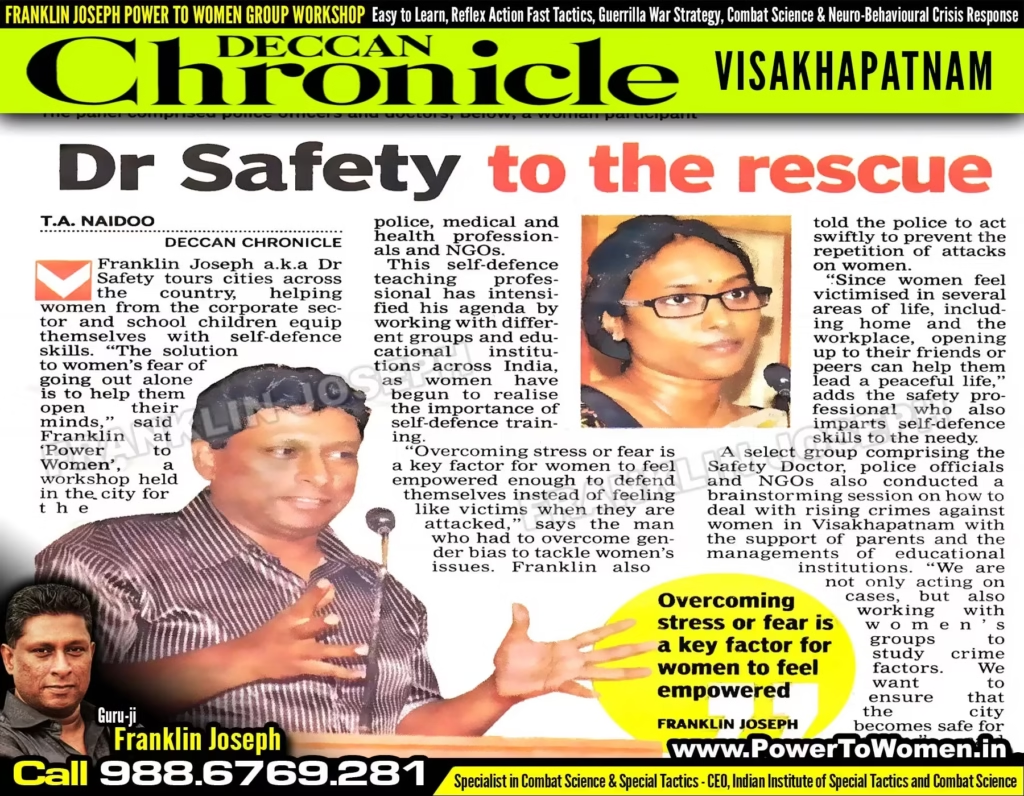
Deccan Chronicle – Newspaper – Dr. Safety to the rescue

Dainik Jagran Newspaper ~ Learn the real self defense from Dr. Safety, Franklin Joseph
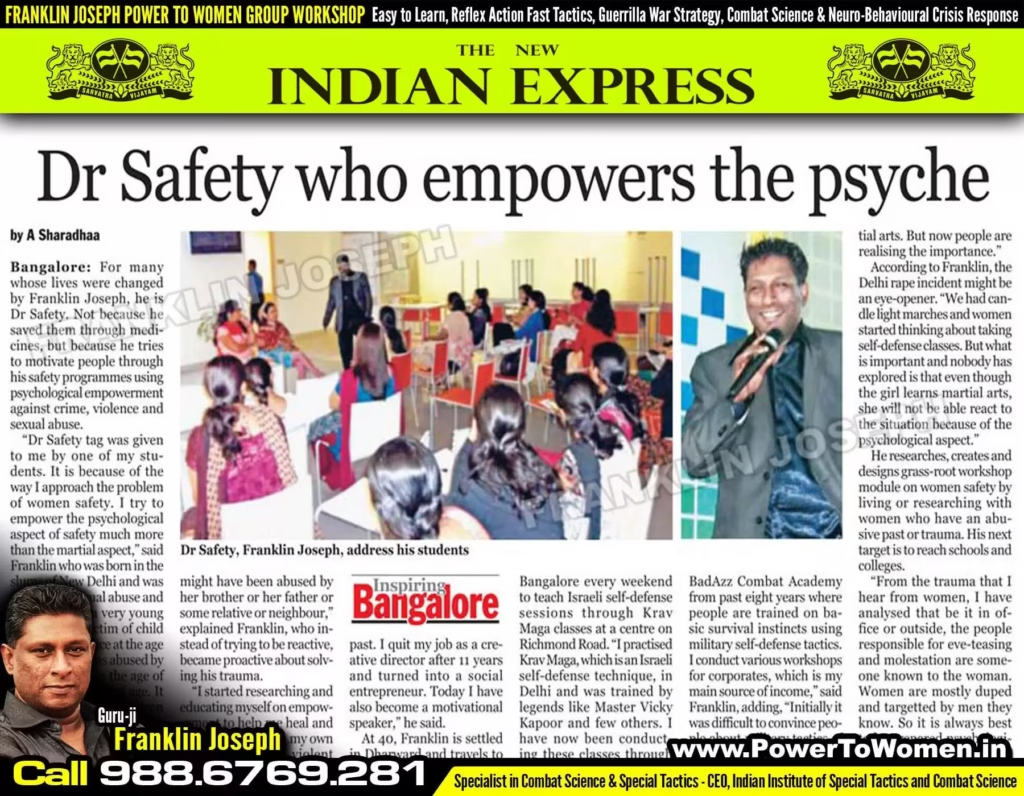
The New Indian Express Newspaper ~ Dr Safety who empowers the psyche
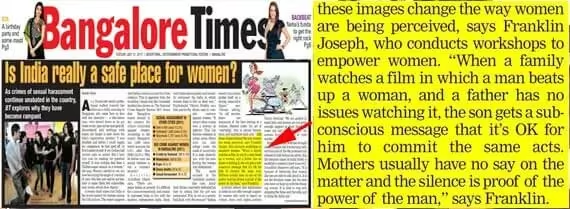
Bangalore Times Newspaper ~ Is India really a safe place for women?

Deccan Chronical Newspaper ~ Krav Maga Work your mind
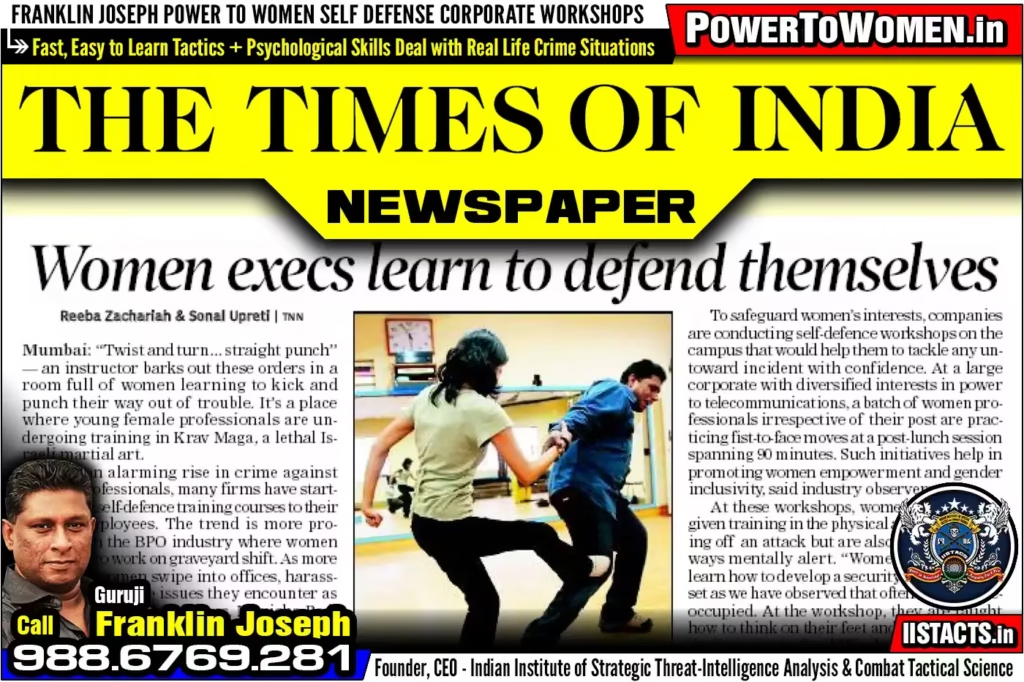
Times of India Newspaper ~ Women execs learn to defend themselves

International Women’s Day 2026 is about POWER TO WOMEN

Female Empowerment or Female Fragility? What Your Self-Defense Workshop Choice Says About How You See Women

Women’s Self-Defense Is Not About Gender. It Is About Surviving Crime

Corporate Women’s Self-Defense Workshop: 10 Red Flags That Your Workshop Is Failing Your Employees

Does the Indian POSH Act Require Female Trainers for Women’s Self Defence Workshops?

What Should You Look For When Hiring a Corporate Self-Defense Instructor?

Quest towards a Warrior Mindset – Ms. Priyamvada, Advocate

Indian Institute of Management, Bengaluru – Women Self Defense Workshop

National Institute of Technology, Tiruchirappalli – Women Self Defense Workshop

Car Tactics – Power To Women Corporate Self Defense Workshop with Psychological Women Empowerment Workshop

Titan ~ 4 Cities – Power To Women Corporate Self Defense Workshop with Psychological Women Empowerment
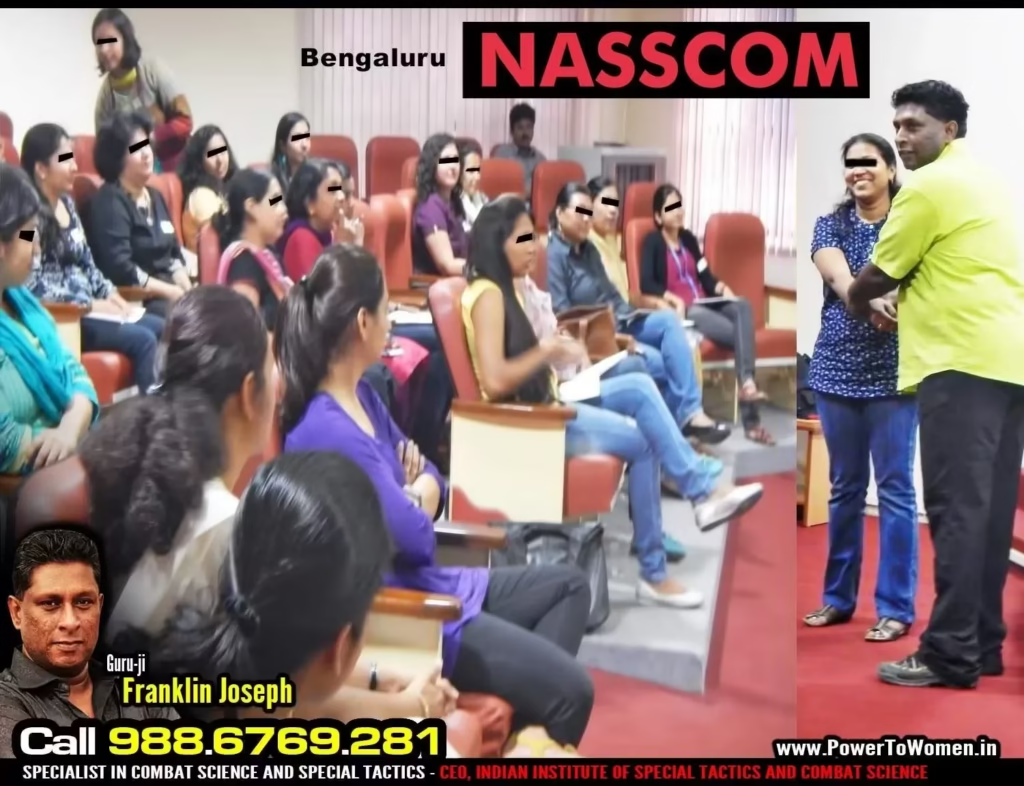
NASSCOM – Power To Women Corporate Self Defense Workshop with Psychological Women Empowerment
About Specialist Franklin Joseph